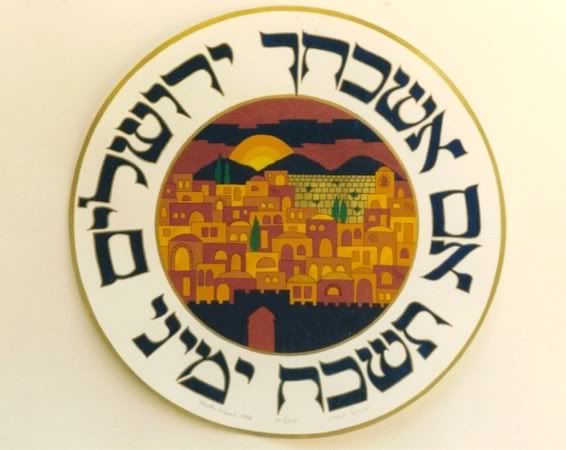
Tonight is erev Tisha B'Av. It's always been a very hard day for me; to understand the imagery that we find in Eicha. Two years ago I sat at the Kotel all day trying to feel the destruction - but I can't - it's so much easier for me to feel the destruction of the nation through the Holocaust, the descriptions provided in the megillah of what the populace went through during the siege. This is why most shuls watch Holocaust movies - because we cannot connect to the Temple - despite our best efforts most of us cannot do it.
XGH says that this phenomenon is proof that we don't really want the Temple back; I don't think so, it's been 2,000 hard years and we - today's Jews - don't really get it. So we take other aspects of Tisha B'Av the other calamities that have befallen us on this day and connect to those.
Is it bad to do so? No, I don't think so, since it's also an integral part of the day. But this year I'm going to make a concerted effort - like I've done in the past - to think about the Avoda in the Beit HaMikdash and what the Churban really was.
I found RWAC's post to be truly moving, because I feel that I will come out of Tisha B'Av feeling very like that. Today I will accept God's judgment, but I'm moving to Israel in a week. I have the pain of packing and moving boxes in my arms and legs; I can't forget that. There is a day after Tisha B'Av and on Tu B'Av I will move to Israel.
This year's Tisha B'Av promises to not be the average Tisha B'Av. It will be hard and special in it's own way.
Showing posts with label Torah. Show all posts
Showing posts with label Torah. Show all posts
Monday, July 23, 2007

Sunday, May 27, 2007
Dairy during Shavuot
For the past two years when Shavuot comes up my wife and I have a whole argument about eating only dairy on Shavuot. She inevitably wins due to either a. "I'm cooking" or b. "We're going to my parents and they only eat dairy". I've tried to convince her that the custom doesn't meant only dairy during the holiday, but to no avail.
I'll show her this post by Harry, but I really don't think that it will have any effect. The next objection will be "But it's my family's minhag and I'm cooking". What can I do?
Well for the next few years we'll be in Israel and there'll only be two dairy meals but I'm lactose intolerant though that doesn't seem to be a reason to stop a minhag. If Harry's post is accurate (I'm assuming it is) most Jews I know are following a mistaken minhag of only having milhig meals and not having both.
I still wont win.
I'll show her this post by Harry, but I really don't think that it will have any effect. The next objection will be "But it's my family's minhag and I'm cooking". What can I do?
Well for the next few years we'll be in Israel and there'll only be two dairy meals but I'm lactose intolerant though that doesn't seem to be a reason to stop a minhag. If Harry's post is accurate (I'm assuming it is) most Jews I know are following a mistaken minhag of only having milhig meals and not having both.
I still wont win.
Tuesday, May 22, 2007
Halacha vs. Kabbala
I found a shiur given by R' David Fink rather enlightening and decided to share it hear. Nothing that follows is my own idea, only Rav Fink's. The original shiur can be heard here. As I only heard the shiur online I do not have any source notes unless Rav Fink said them.
What happens when Kabbala and Halacha tell you to do two different things?
The Tur: Put on Teffilin shel Yad and Barech (l'haniach tefillin), then shel Rosh and make a second Beracha (al mitzvat tefillin).
R' Yosef Karo not only wrote the Beit Yosef and the Shulchan Aruch but was also a noted Kabbalist. He lived in Sfat during the time of the AriZal - in fact, he was his neighbor - and is the author of the Magid Meisharim. This work is a compilation of statements made by R' Karo while in a trance and a Magid spoke through R' Karo. There are times that the Magid and the R' Karo disagreed with each other. Of couse, R' Karo poskens in the Beit Yosef against the Magid. R' Yaakov Emden assumes this because R' Karo was a greater talmid chacham than the magid.
Rav Fink has heard of authors of fiction expressing similar methods. They go into a trance and the characters in the book speak to them and they authors write down the dialogue as they hear it in their minds. Unfortunately this gift is never given to writers of non-fiction. These authors have to work out their solutions rationally unlike the fiction authors that just let it flow.
The halachic R' Karo depended on his reason when writing the Shulchan Aruch, the mystical R' Karo reported his mystical periods in the Magid Meisharim. Whenever there is tension for R' Karo halacha is in accord with the rational reasoning in the Beit Yosef as poskened in the Shulchan Aruch.
Back to the Berachot of Tefillin:
Sefer HaAgur: I found in the Zohar from a saying of Rashbi - a single beracha is to be said on both tefillin together. The teffilin shel rosh on the head correspond to Zachor and teffilin shel yad next to the heart correspond to Shamor. Just as we say Shamor and Zachor were said together at Matan Torah a single beracha covers both tefillin. One should not wait between the two tefillin, one should do both without a hefshek. I am amazed that these great Rabbanim disagree with Rashbi in the Zohar, if the Poskim knew what was said in the Zohar, why did they disagree with it? In any case, the minhag is to make two beracha, but the right thing to do is to make one beracha.
R' Karo: I don't know why the Sefer HaAgur was mystified on this question. There are plenty of other examples between the gemara and the zohar, why is it this one that he's so interested in? In every case the poskim follow the gemara and never the zohar. Even if the poskim knew the zohar they wouldn't care - the reason the poskim say to make two berachot is because that's what it says in the Gemara. All the more so, in the days of the Reshonim the Sefer HaZohar was not yet known. It was transmitted it Rebbe to Talmid for generations and only surfaced published much later. Furthermore, the passage in the Zohar (quoted by the Sefer HaAgur) does not necessarily mean only to make one beracha for both tefillin. What it might mean is that the first beracha applies to both teffilin and therefore one should not interrupt between them, the teffilin shel rosh needs its own beracha. Bottom line - two berachot on Tefillin regardless of what the Zohar says.
We see here one clear example where we follow the Gemara and the Poskim regardless of the Zohar.
The Magen Avraham was the first of the great poskim to systematically apply kabbalistic sources in his halachic discussion. Previous to him people related to the Zohar as a body of matterial that explained to us the inner workings of Torah, the world, and the universe we live him. A philosophical insight into the world. He was therefore bothered between the tension between the Zohar and the Halachic material. He quoted the the Kenesset HaGedola: wherever theres a conflict between the kabbala and the halacha - the halacha is always in accordance with the poskim. He seems to be referring to a situation where all the poskim are on one side and the zohar is on the other side. If the kabbalists are stricter than what is required by the poskim we can be machmir like the kabbalists. any issue that is not mentioned in the poskim - no source in the gemara but does in the zohar - we have no authority to impose the practice upon the people. Only halacha can be forced upon the people, we can try to convince people to follow the kabbalistic method but that's it.
Sometimes people asked R' Moshe Feinstein what is the meaning or reason why so and so poskend this way found in other places. Someone asked R' Feinstein (found in the Iggrot Moshe) why did the Mishna Berurah posken that one who stays awake all night without sleep that he does not make the berachot Bircat haTorah etc.. Whenever there is a machloket amongst poskim and the weight of the Zohar and Kabbalists determine the outcome. In this case the Mishna Berurah should have followed the AriZal to make the beracha. So why did he reject this position? Answer: It's obvious that the idea that the Kabbalists always prevail wherever there is a machloket amongst the poskim that idea only pertains to material in the zohar itself - that prevails. Why? That material comes from the time of the Mishnah. But the works of the later Kabbalists - the AriZal and others - does not have the same weight of the Zoharic literature. Therefore one can poskin the AriZal just like one can poskin against one other posek.
Rav Fink finds it mysterious: The Iggrot Moshe speaks with a very clear voice. He never applies this above rule not even once.
The Chacham Zvi (who was a great Kabbalist in addition to being a noted Posek) when speaking about the Machloket about how one should position his bed (Kabbalists Head West / Feet East vs. Poskim Head North / Feet South) says in a situation where the Zohar is opposed to the Gemara and Poskim - we never abandon the poskim in favor of the position of the Zohar. When in comes to Halacha we ignore the Zohar and rely on the Poskim. However, in a situation where the Poskim are divided it is correct (note: he does say must) to follow the Kabbala.
His son, R' Yaakov Emden, even though he denied the antiquity of the zohar in Mitpachat Sefarim, was a major Kabbalist. I remember that my father zt"l lived across the street from the non-Jewish orphanage; his bed was oriented like the mekubalim say and not like the poskim. He himself wrote one should follow the poskim and not the kabbalah, but I saw in practice he did the opposite from what he wrote. In order for there to be a machloket people need to be in each others presence, it is improper to say two people who are unaware of each others opinion it is not proper to call this a machloket. Did the poskim know the words of the Zohar becasue it was being transmitted secretly and these poskim are outside of the chain of tradition. Perhaps they would have changed their mind had they known. We should not be concerned that we reject mystical ideas in Halacha - elu v'elu divrei elokim chaim. [R'
How does this come down in the more recent poskim?
The Munkatcher Rav (R' Elazar Shapira) - a noted posek and mekubal - it's important to bear in mind the difference between nigleh and nistar (revealed and secret wisdom). When I study the Zohar and words of the great Kabbalists I think of myself as learning nigleh - revealed wisdom. When I study Gemara, the Rambam, the Tur, and the Shulchan Aruch I think of myself as learning nistar - the secret wisdom of Torah. The works of the kabbalists talk about Olam HaSefirot they say they talk about the mystical reality of Sefirot and they are. The Halchic literature does not say they are talking about the mystical reality but indeed they are this is why I call them Nistar - hidden.
The Shulchan Aruch HaRav - whenever there is a disagreement between the kabbalits and the poskim - you should posken like the gemara and the poskim. Make two berachot on tefillin. The Baal HaTanya accepts the position of the Magen Avraham , we can require people to follow the gemara and no the Zohar. Halacha and Halachic sources always prevail over the Zohar and Kabbalistic sources.
Rav Fink notes that Chabad Chassidim do not follow this position. In every conflict between the Gemara and the Zohar they follow the Zohar instead of the ruling of the Baal HaTanya and make one beracha on tefilin. The Shaar HaKollel - R' Avram David Livat - I heard from a Chasid before he died that the Baal HaTanya had been asked about this question. Our minhag is to follow the Mekubalim instead of the poskim. Why then did you write in Shulchan Aruch HaRav to follow the poskim? I only wrote that because the poskim write to follow the poskim, but the mekubalim all write to follow the Zohar. It cannot be that the mekubalim would not follow the gemara and therefore the question doesn't make sense. This is what I heard from that Chasid before he died.
This is a tradition starting three generations after the Baal HaTanya. This is the reason the Baal HaTanya started to write a second edition of the Shulchan Aruch HaRav but only got a few pages in where he surely would have poskened like the mekubalim against the poskim.
Rav Fink: We find many stories (folk literature) that a major posek changed his mind on their deathbed. These stories are possibly true and it surely does happen and I doubt that it happens every time it is reported.
The traditions of the Gra weigh heavily on the Aruch HaShulchan and writes: When there is a machloket between the Zohar and the Poskim we of course follow the Poskim. It is correct to be machmir like the Zohar when they are machmir. One cannot require one to follow the Zohar. I have a tradition (from the Gra) that is impossible that there is a true conflict between the Gemara and the Zohar unless of course there are multiple opinions in the Gemara and the Zohar is holding like one opinion there. People have an incorrect understanding of the Zohar if they think there is a machloket between them
Tuesday, March 20, 2007
The Haggadah, Rosh Chodesh, and Denzel Washington
Since it's Rosh Chodesh I thought this was appropriate:
The Hagaddah Reads:
This reminds me very clearly of a scene in The Hurricane where Denzel Washington's character Hurrican Carter refuses to act like an inmate.
The Hagaddah Reads:
It could be from Rosh Chodesh, but the verse says, "On that day." If on that day then it may be during the day, the verse says, "Because of this." Because of this I only said at the hour when matzah and maror are before you.Light of Redemption: A Passover Haggadah Based on the Writings of Rav Kook:
The Midrash Mechilta (Bo 17) from which this passage is taken suggests that we should be able to fulfill the mitzvah of relating the story of coming out of Egypt from the beginning of the month of Nisan. This is due to an interpretation of the verse in the Torah that commands us to relate the story of the exodus from Egypt to our children. This verse is a crucial source for the entire mitzvah of the Seder night.Rav Kook continues to go on and explain why Rosh Chodesh could not be the time, but the point here is beautiful. We became free when we were given the mitzvah of Rosh Chodesh, we were no longer slaves. We looked like slaves, we acted like slaves, but in our minds we were not. We made our own time.
"You shall tell your son on that day, 'Because of this God did this to me when I left Egypt' " (Shemot 13:8). The midrash suggests that theoretically we could perform this mitzvah starting from Rosh Chodesh Nisan.
This is because the redemption from Egypt actually started on the 1st of Nisan. On this day the Jewish people recieved the first mitzvah, that of establishing a lunar calendar (see Shemot 12:2 adn Rashi on the Torah, BeReishit 1:1). At this point the Jewish people introduced their own way of counting time and had control of their time; they started to be free from the slavery of Egyptians.
p.28
This reminds me very clearly of a scene in The Hurricane where Denzel Washington's character Hurrican Carter refuses to act like an inmate.
I will bend time to my own clock.It works, when we control our own time we are no longer their slaves.
When the prison is awake, I will sleep.
When they sleep, I will wake.
I will live neither in their cell...
nor in my own heart,
only in my mind...
and my spirit.
Sunday, March 18, 2007
Kosher for Passover Gasoline
There is a certain e-mail circulating around the Jewish e-mail world right now that is supposedly an article written in the Bergen County Jewish Times suggesting that ethanol-free gasoline will be made available for people who do not wish to use a derivative of corn on Pesach.
My wife is subscribed to a community based list-serve where she was sent a copy of this e-mail. This list-serve has dozens of e-mails going back and forth discussing the various halachic reasons why such a product would be good to use on pesach. Only a few people have realized that this is a joke.
Here is the text of the e-mail:
What bothers me is not that someone is still having some Adar fun, but that people are actually believing this. Some of the people responding to the original e-mail are suggesting that this is some sort of Government plot to lift the embargo on Cuba, as well as discussing the halachic problems of eating peanuts on Pesach - since they might be Kitnyot. And even if they are we shouldn't be using derivatives of Kitnyot on Pesach.
[No one seems to remember that until a few years ago only Peanut Oil was Kosher L
L'Pesach when finally other Pesachdik oils came out.]
The discussion came to new hights when raui la achilat kelev was brought up and someone suggesting that we take a bowl of gasoline and give it to a dog.
Well someone has certainly had their fun, but I seriously hope that no one takes this too seriously and next year we actually see this type of nonsense.
My wife is subscribed to a community based list-serve where she was sent a copy of this e-mail. This list-serve has dozens of e-mails going back and forth discussing the various halachic reasons why such a product would be good to use on pesach. Only a few people have realized that this is a joke.
Here is the text of the e-mail:
Bergen County Jewish TimesThere is no such newspaper as the "Bergen County Jewish Times" and the people named in the article only show up (in a Google search) as being linked to this article.
By Danielle Wolfberg and Henry Lorman
Teaneck, New Jersey
March 1,2007
Yaniv Ban-Zaken, a local gas station owner, will be selling Kosher for Passover gasoline during the holiday this year. The move, Ben-Zaken says, has become necessary due to the increased ethanol content in gasoline required by the government. The ethanol is typically derived from corn, which is a forbidden food for Jews on Passover. And, according to Ben-Zaken, underJewish law, it is also forbidden to derive any benefit from corn.
"We will be providing a number of services to anyone interested in making their motor vehicle Kosher for Passover," Ben-Zaken says. Services will include siphoning off the non-Kosher gasoline and replacing it with the Kosher gasoline. The entire process will be supervised by Rabbi Yitzchok Mendelbaum. A special exemption to the EPA rule regarding the plant ethanol content of gasoline had to be obtained from the government to allow for the use of this gasoline.
The move has created some controversy among local community leaders. Rabbi Shalom Silver, of Congregation Ohel Emeth in Teaneck, has recommended to his congregants that they not buy the gasoline. "Although Jews of Ashkenazi descent are not permitted to eat corn on Pesach, they are permitted to derive benefit from corn byproducts, such as gasoline with ethanol additives," he said.
However, Rabbi Mordechai Silver (no relation to Shalom Silver), of Yeshivas Torah Ohr in nearby Englewood, disagrees, and maintains that while it might technically be acceptable to use mass-produced gasoline, those who can afford to purchase the new alternative should. "In Jewish law, we have a principle of lifnim mshuras hadin--going above and beyond the basic requirements of the law," he explained in an email. "Thank G-d, many people in the area can afford to do so in this case."
Some local Jewish leaders have also complained about the high price of the ethanol-free gas, which Ben-Zaken estimates will be $9.69 per gallon, but Ben-Zaken insists that it is necessary. "The Kosher gas is made in small quantities and not mass produced, so the costs are high." In fact, Ben-Zaken, an immigrant from Israel who is not himself religious, claims that he will not be making any profit on the sale of the Kosher gas. "I'm doing this more as a community service. My hope is that people will be more likely to patronize my station the rest of the year." Julio Sanchez, one of Ben-Zakens employees, also expressed some concern over the high price, explaining that it might drive away customers and reduce his income from tips. Co-worker Naveen Samhari disagreed, because, as he says, "Orthodox Jews are among the best tippers in the area."
Ben-Zaken also says he will be contracting with a local car rental agency to provide customers with a Kosher for Passover car if they would prefer not to use their own. This will also save the time of having to clean chametz from the car before Pesach--time that many local two-income families do not have. "Jews use different dishes for Passover. They ought to be able to use a different car, as well." Ben-Zaken says.
What bothers me is not that someone is still having some Adar fun, but that people are actually believing this. Some of the people responding to the original e-mail are suggesting that this is some sort of Government plot to lift the embargo on Cuba, as well as discussing the halachic problems of eating peanuts on Pesach - since they might be Kitnyot. And even if they are we shouldn't be using derivatives of Kitnyot on Pesach.
[No one seems to remember that until a few years ago only Peanut Oil was Kosher L
L'Pesach when finally other Pesachdik oils came out.]
The discussion came to new hights when raui la achilat kelev was brought up and someone suggesting that we take a bowl of gasoline and give it to a dog.
Well someone has certainly had their fun, but I seriously hope that no one takes this too seriously and next year we actually see this type of nonsense.
Thursday, February 22, 2007
The Mishkan and Why We Needed to Build it
There is a machloket among the meforshim as to whether the detail given regarding the mishkan had a specific purpose. The two sides basically fall between the Abarbanel, who states that they must have a more important meaning than the pshat, and the Rambam, who believes that the specific details are just that - the blueprints for the more important part, the mishkan - and that we shouldn't try to understand each minutiae.
Nechama Leibowitz's comments in "Terumah 4" present both sides and give supporting evidence and other meforshim who agree with each. In my view I find the opinion of Abarbanel more convincing. It seems to me that if the minutiae meant nothing then why include them? The Torah spends very little time explaining the lives of the avot and goes in to great detail here (and other mitzvot). We have a Torah sh'baal peh to help us understand what is not written down - it seems that God did not want us to forget the detail.
The Midrash Raba on Parshat Terumah begins by saying that v'yichu li - take for me - as opposed to v'yitnu - give to me - means that we have the ability to acquire God through talmud torah. By contributing to the building of the mishkan we are acquiring Hashem. The midrash goes on to describe a parable about a King and his daughter's new husband who wants a room in the new couples house to stay close to her. The midrash says that this is similar to the purpose of the mishkan, that we need to build a place for Hashem so that he can be close to the Torah (the daughter). According to this Midrash asu li mikdash does not just mean build for me a mikdash, but rather as a plea to us - when we learn Torah we are giving Hashem a place to dwell. Talmud Torah is not just a necessary endeavor in the life of a Jew but is k'neged kulam the greatest venture we can take.
The building of the Mishkan has a purpose, in fact it has multiple purposes, to continue the revelation at Sinai, to give korbanot, to make atonement for our sins, but the primary purpose that we built the mishkan and it didn't just fall from the sky was so that we could work for it, to toil in the details. That in order to make a makom for God on earth we must strive and toil to make it perfect, it's an allusion to our selves. In order to make ourselves godly - kadosh - we must make a concerted effort to get there.
Nechama Leibowitz's comments in "Terumah 4" present both sides and give supporting evidence and other meforshim who agree with each. In my view I find the opinion of Abarbanel more convincing. It seems to me that if the minutiae meant nothing then why include them? The Torah spends very little time explaining the lives of the avot and goes in to great detail here (and other mitzvot). We have a Torah sh'baal peh to help us understand what is not written down - it seems that God did not want us to forget the detail.
The Midrash Raba on Parshat Terumah begins by saying that v'yichu li - take for me - as opposed to v'yitnu - give to me - means that we have the ability to acquire God through talmud torah. By contributing to the building of the mishkan we are acquiring Hashem. The midrash goes on to describe a parable about a King and his daughter's new husband who wants a room in the new couples house to stay close to her. The midrash says that this is similar to the purpose of the mishkan, that we need to build a place for Hashem so that he can be close to the Torah (the daughter). According to this Midrash asu li mikdash does not just mean build for me a mikdash, but rather as a plea to us - when we learn Torah we are giving Hashem a place to dwell. Talmud Torah is not just a necessary endeavor in the life of a Jew but is k'neged kulam the greatest venture we can take.
The building of the Mishkan has a purpose, in fact it has multiple purposes, to continue the revelation at Sinai, to give korbanot, to make atonement for our sins, but the primary purpose that we built the mishkan and it didn't just fall from the sky was so that we could work for it, to toil in the details. That in order to make a makom for God on earth we must strive and toil to make it perfect, it's an allusion to our selves. In order to make ourselves godly - kadosh - we must make a concerted effort to get there.
Thursday, February 15, 2007
The Torah of Eretz Yisrael
Rav Kook on Bereishit 2:12:
"And the gold of that land is good" [Gen. 2:12].Why is the Torah suddenly interested in the quality of gold? Was this verse written for prospectors of rare metals?
The Midrash explains that the land referred to is Eretz Yisrael (the Land of Israel), and the precious commodity is none other than the Torah itself. The Midrash then declares,
"This teaches that there is no Torah like the Torah of the Land of Israel" [Bereishit Rabbah 16:4].This is a pretty remarkable statement. Is there really a different Torah in the Land of Israel? And in what way is it superior to the Torah outside of Israel?Details and General Principles
According to Rav Kook, the Torah of Eretz Yisrael is fundamentally different in its method and scope. The Torah of the Diaspora focuses on the details — specific laws and rules. The Torah of the Land of Israel, on the other hand, uses a more holistic approach. It connects those details with their governing moral principles.
This approach is particularly needed in our time of national renascence. We must reveal the truth and clarity of our Divine treasure. We must demonstrate the beauty and depth of practical mitzvot, by endowing them with the light of the mystical and philosophical side of the Torah. And the true depths and foundations of Torah can only be experienced in the Land of Israel.
Naomi is applying for scholarships to help us finance our move to Israel, one particular one asked why she'd rather study in Israel and not in the US. We had discussions about it and I could not explain myself to her. Much like a conversation I had with a woman waiting by the trempiada on the way to Gush Etzion at 3am. All I could say was unintelligible sentences about Torah feels different in Israel. I think this statement by Rav Kook (as Rav Morrison explains) explains exactly what I was feeling.
Monday, February 12, 2007
Seforim Sale (Year Three)
This was the third year in a row that I've made the trek from Maryland to YU for the Seforim Sale. I was not as "successful" as I was last year, but I did pick up a few seforim that I'm really excited about.
- Nechama Leibowitz Studies on the Torah
- Rav Soloveitchik Days Of Deliverance: Essays on Purim And Hanukkah
- Rav Soloveitchik Festival Of Freedom: Essays on Pesah and the Haggadah
- Aish Kodesh by R' Kalonymus Kalman Shapira of Piasetzno
- Gold From the Land of Israel - Rav Kook onParshat HaShavua
[The book and more can be found online here] - Naomi bought a few cookbooks for herself
- They only had one volume of Ayin Aiyeh and it was $42 - I think I'll wait till Israel
- I've been looking for a good printing of Aruch HaShulchan for a while and I found one (the Oz V'Hadar one) but I didn't get it, but noticed that it's printed with "Opinions of the Mishna Berurah". Same thing for new printings on the Chayei Adam. Since when were we not good enough to look at either of these two seforim without knowing what the Mishna Berura ruled.
- I've got two other books of the Rav Soloveitchik series above (Family Redeemed and Worship of the Heart) both are fantastic. There's an article on the Amidah in Worship that is worth the price alone. Absolutely incredible stuff.
Saturday, February 03, 2007
Blue 32, Blue 32, Hut - Hut... Reflections on the Parsha
[I wrote this pre-Shabbos but didn't have enough time to post it]
Shmot 13:18:
The Ben Ish Chai - R' Yosef Chaim Baghdadi - says that Pharaoh is a man who uses trickery and deception and God does this to turn the tables on him. God couldn't just let B'nei Yisrael go without doing something to punish Pharaoh and his soldiers. The reversal of B'nei Yisrael's route was all part of God's plan to convince Pharaoh to send his army out after them - think smoke and daggers.
Maybe I had the Super Bowl on my brain - sorry ADDeRabbi, I'm not having a Super Bowl party this year, the Steelers and Eagles aren't playing - but it seems to me that this sounds like a football play. Fake right draw them into the back field and we'll head left and they'll never know what hit 'em.
Gut Voch.
Shmot 13:18:
But God made the people take a round-about way, the way of the wilderness of the Red SeaThis reversal of B'nei Yisrael (or rather their route) is rather odd. Why not take them directly to Yam Suf? Why do they have to wait there? Why send them on one path only to tell them to turn around and go another way? Shouldn't God have just said "Go to Yam Suf"? Yitziat Mizrayim is the seminal event in Jewish history but wouldn't the Exodus have been "good enough" with the Jews leaving, why did God have to drown Pharoah? If as the Rambam suggests that God cannot change his mind what is going on here? Clearly God must have done this on purpose.
The Ben Ish Chai - R' Yosef Chaim Baghdadi - says that Pharaoh is a man who uses trickery and deception and God does this to turn the tables on him. God couldn't just let B'nei Yisrael go without doing something to punish Pharaoh and his soldiers. The reversal of B'nei Yisrael's route was all part of God's plan to convince Pharaoh to send his army out after them - think smoke and daggers.
Maybe I had the Super Bowl on my brain - sorry ADDeRabbi, I'm not having a Super Bowl party this year, the Steelers and Eagles aren't playing - but it seems to me that this sounds like a football play. Fake right draw them into the back field and we'll head left and they'll never know what hit 'em.
Gut Voch.
Sunday, January 21, 2007
Wedding D'var Torah - The No Longer Lonely Man of Faith
At the Chatan's Tisch I was unable to give my D'var Torah due to time restrictions. We could not find the Rav who was honored with reading the T'naim for - what seemed like - fifteen minutes so I did not have time to share my speech then.
I wrote this speech in ten minutes sometime the week before the wedding at work and never saw it again until the day of the Chatanah. I thought that some of you might like to read it - though a few of you already have.
I wrote this speech in ten minutes sometime the week before the wedding at work and never saw it again until the day of the Chatanah. I thought that some of you might like to read it - though a few of you already have.
In Genesis 2:18 the Torah tells us "Lo Tov Hiyot HaAdam L'vado", which is usually translated as "It is not good for man to be alone." This verse is often used when speaking about marriage. However, the verse seems to be misunderstood. Rav Soloveitchik explains that the word would be translated as loneliness or aloneness. Preferring the translation "It is not good for man to be lonely", the Rav shows us that man needs more than a helper- that two can accomplish more than one. Man cannot be lonely. Man cannot live up to his potential - again, not a utilitarian purpose - but for ontological reasons - without an Ezer K'negdo - without a soul mate. This is what soul mate really means, a person with whom we achieve more, a person who gives life meaning and direction. A marriage is always greater than the sum of its parts.It was a wonderful wedding, more than I could have ever wished or asked for. This past week of Sheva Brachot has been the most exhausting week ever. We've been up and down the east coast (my parents are making "East Coast Tour" t-shirts). Now it's time to go back to work and finally settle in.
Lo Tov Hiyot HaAdam L'vado - It is not good for man to be lonely. I am no longer lonely.
Thursday, January 04, 2007
Gan Eden and Olam HaBa: Immortality and Omniscience
Back in April I wrote a post entitled Adam and Eve: Is Gan Eden Really Our Goal? I argued that the planting of the two trees inside the garden and the subsequent eating of the Etz HaDa'at Tov u'Ra was equal to the choosing of knowledge over life. And thus when God expels Adam and Chava from the garden they are forced to remember how tough life is an eternal remembrance of that choice.
I'd like to revisit that discussion.
An interesting side point: How does this fit in with the Rambam? Rambam realized that there can never again be the combination of immortality and omniscience as there was in Gan Eden. In describing Olam HaBa he speaks about the immortality of the mind because - well for one thing, his Aristotelian foundation - but also because he cannot fathom that Gan Eden was anything more than a dream. I believe that the Rambam would argue - not that creation did not happen - but rather that Gan Eden was not the earth that we understand. It was not a physical place, you cannot go to the spot where it was. Omniscience, by definition for the Rambam, excludes a physical body because God is omniscient and if/when people become omniscient we cannot have a body either.
I'd like to point out that I don't believe that the Rambam would suggest that the human mind could, in Olam HaBa, achieve the same omniscience that God has, but rather that during our lives we strive for that goal. We do everything we can to achieve that omniscience because we have an eternal desire for what was lost in Gan Eden - immortality and omniscience.
I'd like to revisit that discussion.
God purposely planted the Paradise for man, who was called upon to cultivate and guard it. Man is encouraged to build, to plant, to beautify his life, to enjoy his life as much as he can. 'And the Lord God planted a garden eastward, in Eden, and there He placed man whom He had formed; and the Lord God made grow out of the ground every tree delightful to the eye and good for food...' (Gen. 2:8-9). But two horrible fears haunt man steadily, trailing him like an everlasting shadow: the fear of nihility, of nonbeing - death - and the fear of ignorance. Man wants to live and to know. He is eager to lead an intelligent, enlightened, inextinguishable existence. His greatest aspiration, his most fascinating dream is to defeat death and to grasp the mysterium magnum, the great mystery of creation. God did plant the garden with trees pleasant to look at and delightful as far as taste is concerned. And in the middle of the garden grew the two mysterious trees representing the two basic aspirations of man: to live and to know. Yes, God planted the garden in Eden in order to place there the man whom He formed, for man is entitled to desire, to quest, to long for and be fascinated by something great and wonderful - immortality and omniscience.The Rav would have likely amended my conclusion by stating that God was punishing Adam and Eve not because she ate of the tree - it was only a manifestation of the desire for immortality and omniscience - but rather because she chose one of those desires over the other. We live in a world where immortality is out of our reach, we will never be able to find that "Fountain of Youth" to give us immortality. Likewise, we will never be omniscient. Despite our best efforts to record all of human intelligence - as the encyclopedia was originally intended by the French after the French Revolution of 1789 and wikipedia - we will never be omniscient.
Rav Joseph B. Soloveitchik Family Redeemed p. 10-11
An interesting side point: How does this fit in with the Rambam? Rambam realized that there can never again be the combination of immortality and omniscience as there was in Gan Eden. In describing Olam HaBa he speaks about the immortality of the mind because - well for one thing, his Aristotelian foundation - but also because he cannot fathom that Gan Eden was anything more than a dream. I believe that the Rambam would argue - not that creation did not happen - but rather that Gan Eden was not the earth that we understand. It was not a physical place, you cannot go to the spot where it was. Omniscience, by definition for the Rambam, excludes a physical body because God is omniscient and if/when people become omniscient we cannot have a body either.
I'd like to point out that I don't believe that the Rambam would suggest that the human mind could, in Olam HaBa, achieve the same omniscience that God has, but rather that during our lives we strive for that goal. We do everything we can to achieve that omniscience because we have an eternal desire for what was lost in Gan Eden - immortality and omniscience.
Monday, December 18, 2006
The "Real" Miracle of Chanukah?
I went back to UMD this past Shabbat and the student who gave the D'var Torah at Shalosh Shiddus asked an important question: "Why in all of the nessim of Chanukah do we commemorate the event by lighting a menorah?" His answer, which came after some proofs, is that by acknowledging a small nes it allows us to appreciate the larger ones more.
Unfortunately I don't know his name, but I think he's right on target.
Rav Shlomo Aviner points out that when there's no Shemen Tahor it is possible to light the menorah with Shemen Tameia. When Rov Am Yisrael is Tamei it is still possible to bring the Korban Pesach and to build the Temple. The same din is applied when there's no Shemen Tahor; it is mutar to light the menorah with Shemen Tameia because it's a communal activity. (Tal Hermon vol. 2 p. 85)
So, if there is the case, why the big deal about finding a flask of pure oil and, more importantly, why did HaShem deem it necessary to make it last for eight days? Rambam tells us that this is how long it takes to produce Shemen Tahor, but why does any of this matter if they can use the Shemen Tameia instead? Why the נס פך השמן?
I think the answer comes back to the student's original question. "Why in all of the nessim of Chanukah do we commemorate the event by lighting a menorah?" It is the seeming triviality of the nes that makes it important. The Jews in the Temple went out of their way to find the Shemen Tahor and their actions were rewarded with a nes.
If this idea is accurate then HaShem davka made the נס פך השמן so that we would appreciate the Chag more. Instead finding us celebrating the נס הניצחון הצבאי in some other way, we are found at home bringing light into the world with our families.
Chag Orim Sameach
Unfortunately I don't know his name, but I think he's right on target.
Rav Shlomo Aviner points out that when there's no Shemen Tahor it is possible to light the menorah with Shemen Tameia. When Rov Am Yisrael is Tamei it is still possible to bring the Korban Pesach and to build the Temple. The same din is applied when there's no Shemen Tahor; it is mutar to light the menorah with Shemen Tameia because it's a communal activity. (Tal Hermon vol. 2 p. 85)
So, if there is the case, why the big deal about finding a flask of pure oil and, more importantly, why did HaShem deem it necessary to make it last for eight days? Rambam tells us that this is how long it takes to produce Shemen Tahor, but why does any of this matter if they can use the Shemen Tameia instead? Why the נס פך השמן?
I think the answer comes back to the student's original question. "Why in all of the nessim of Chanukah do we commemorate the event by lighting a menorah?" It is the seeming triviality of the nes that makes it important. The Jews in the Temple went out of their way to find the Shemen Tahor and their actions were rewarded with a nes.
If this idea is accurate then HaShem davka made the נס פך השמן so that we would appreciate the Chag more. Instead finding us celebrating the נס הניצחון הצבאי in some other way, we are found at home bringing light into the world with our families.
Chag Orim Sameach
Sunday, December 10, 2006
On the Bus Beating
ADDeRabbi and Harry have posted great comments on the recent Bus Beating. I don't think she was doing - as Harry termed it - a Rosa Parks style sit-in. First off, she wasn't doing anything contrary to the signs on the bus. Rosa was a hero, this woman did even more.
I am copying the comments I left on Harry's post because I feel very strongly that this needs to be spread to as many people as possible so that the outrage becomes known; to hopefully prevent this Chillul HaShem from ever happening again.
I am copying the comments I left on Harry's post because I feel very strongly that this needs to be spread to as many people as possible so that the outrage becomes known; to hopefully prevent this Chillul HaShem from ever happening again.
There are many comments in this thread that as an Orthodox Jew I find truly disturbing. It is no wonder that the Chiloni world hates Charedim so much. For all of the Ahavas Yisroel that we're supposed to have we can't even treat a woman - who may or may not be in the wrong -with simple Kavod HaBrios. Explain to her why the community has the feelings it does, talk to her. Treat her with dignity - she'll listen.
Egged is not a Halachic company - it is however a company that will abide by Halacha if the community demands it. If the bus wasn't a Mehadrin bus then it wasn't a Mehadrin bus and the Community obviously doesn't care enough to go through the process of getting it fixed.
That's the end of the story. Whatever wrong she did shouldn't even be discussed; the community has decided it doesn't care enough to prevent something like this from happening.
Wednesday, November 15, 2006
Parshat Chayei Sara: The Transition Begins from Avraham to Yitzhak
At the beginning of Parshat Chayei Sara, Avraham buys a plot of land in Hevron to bury her. While this is very clearly l'cvodah it also has very important ramifications for Yitzhak. I think the following quote does a great job explaining why.
Even with the best training and the best teachers in the world, the student (Yitzhak) needs to be receptive to the transmission. After Sara's death, Yitzhak is so grief stricken that Avraham is forced to find ways to help him deal with the pain and move on. This is a two step process: 1. Bury Sara 2. Yitzhak shall be married.
Thus we see that despite the fact that Yitzhak never sees his father again from the time of the Akeidah to Avraham's death, Yitzhak will clearly understand (if he has not understood it already) that Avraham was preparing him to perpetuate the nation.
Ownership of burial land is crucial for both familial and political reasons. Sarah would have received a decent burial regardless of whether Abraham had purchased the cave. But Abraham has in mind also and especially on what is needed for future generations, beginning with Isaac. By purchasing a family burial site, Abraham provides as a permanent holding a special place where the ancestors may always "dwell" among the living, a place of memory and filial piety. Indeed, Abraham is arranging his own place of internment and safeguarding it in advance through purchase so that his son will have a secure place to bury him, side by side with Sarah, his wife and Isaac's mother. Isaac will not need to go begging for burial in Hittite sepulchres; Isaac will not need to bargain as Abraham had done; Isaac will know where his loss should lead him: back to his ancestral roots. Even without further instruction, Isaac at the time of his father's death will be directed to reunite his father with his mother and to recognize in their union the wondrous source of his being. He will be moved to recall their deeds. He will be encouraged to try to walk thereafter in their ways... The burial arrangements that Abraham makes today for Sarah (and himself) will speak for him to Isaac after Abraham has died, precisely when Isaac will need to hearken.Even in grief Avraham has his wits about him to recall what his goal in life truly is: to found a great nation. That end goal cannot be forgotten even for one moment, by the end of his life Avraham has developed into the great father that we needed for the new nation.
Leon R. Kass, The Begining of Wisdom: Reading Genesis p.366
Even with the best training and the best teachers in the world, the student (Yitzhak) needs to be receptive to the transmission. After Sara's death, Yitzhak is so grief stricken that Avraham is forced to find ways to help him deal with the pain and move on. This is a two step process: 1. Bury Sara 2. Yitzhak shall be married.
Thus we see that despite the fact that Yitzhak never sees his father again from the time of the Akeidah to Avraham's death, Yitzhak will clearly understand (if he has not understood it already) that Avraham was preparing him to perpetuate the nation.
Friday, October 27, 2006
The Conservative Movement and Homosexuality
In March the Committee for Jewish Laws and Standards (CJLS) of the Conservative Movement postponed their decision on the allowance of Homosexuality in the movement to December. I posted a few times previously regarding my feelings on the issue (here, here, and here).
In deference to a few former roommates and friends that currently attend JTS (one of whom is a very outspoken supporter of the proposal) I try to be as civil as I can. In short I think the issue is very clear: accepting Gays and Lesbians into Rabbinic positions is tantamount to rewriting the Torah.
I re-stumbled across KeshetJTS's website (the Pro-Gay group at JTS) and noticed this article entitled: Does the Old Testament Really Condemn Homosexuality? by Rabbi Michele Brand Medwin of Binghamton, NY.
Quoting the obvious psukim (Vayikra 18:22 etc.) she looks at how the word Toeva (abhorrence) is used in other contexts. They all seem to deal with Avoda Zara. Since, she concludes, "Homosexuality was used as a pagan ritual. God was not condemning the act of homosexuality itself. God was condemning the pagan ritual act of homosexuality and all that is associated with it." But the homosexual act is actually allowed according to Brand.
"In today’s world this prohibition now has no meaning. We are no longer threatened by Canaanite pagan religion and homosexuality today is not a pagan ritual. Homosexuality in Biblical terms is no longer an issue for us today."
I'm sure it's clear that I think she's completely off base here, but this has always been the problem of finding Ta'amei HaMitzvot (reasons for the commandments) - once you "find" the reason, if it no longer applies then what good is it? As was pointed out to me once (maybe in the name of Rav Hirsch) that Ta'amei Hamitzvot really should be translated as flavors of the Commandments. Instead of trying to figure out what God was commanding this for, we've come to understand what the mitzvah means to us. A subtle but importance difference.
Rabbi Brand believes she's figured it all out, and in only four pages too, something that no other Torah scholar in the previous three thousand plus years has been able to do either. Sorry for the sarcasm, but I don't know how else to react.
In deference to a few former roommates and friends that currently attend JTS (one of whom is a very outspoken supporter of the proposal) I try to be as civil as I can. In short I think the issue is very clear: accepting Gays and Lesbians into Rabbinic positions is tantamount to rewriting the Torah.
I re-stumbled across KeshetJTS's website (the Pro-Gay group at JTS) and noticed this article entitled: Does the Old Testament Really Condemn Homosexuality? by Rabbi Michele Brand Medwin of Binghamton, NY.
Quoting the obvious psukim (Vayikra 18:22 etc.) she looks at how the word Toeva (abhorrence) is used in other contexts. They all seem to deal with Avoda Zara. Since, she concludes, "Homosexuality was used as a pagan ritual. God was not condemning the act of homosexuality itself. God was condemning the pagan ritual act of homosexuality and all that is associated with it." But the homosexual act is actually allowed according to Brand.
"In today’s world this prohibition now has no meaning. We are no longer threatened by Canaanite pagan religion and homosexuality today is not a pagan ritual. Homosexuality in Biblical terms is no longer an issue for us today."
I'm sure it's clear that I think she's completely off base here, but this has always been the problem of finding Ta'amei HaMitzvot (reasons for the commandments) - once you "find" the reason, if it no longer applies then what good is it? As was pointed out to me once (maybe in the name of Rav Hirsch) that Ta'amei Hamitzvot really should be translated as flavors of the Commandments. Instead of trying to figure out what God was commanding this for, we've come to understand what the mitzvah means to us. A subtle but importance difference.
Rabbi Brand believes she's figured it all out, and in only four pages too, something that no other Torah scholar in the previous three thousand plus years has been able to do either. Sorry for the sarcasm, but I don't know how else to react.
Friday, October 13, 2006
M'Yamino Aishdat Lamo
We spend the entire month of Tishrei renewing and rejuvenating ourselves - spiritually and physically. After Rosh HaShana, Yom Kippur, Sukkot we end the month with Shmini Atzeret and Simchat Torah. I find it quite telling that the last thing we renew is the Torah. Our guide to life renews itself along with us.
In the last section of the Torah that we read we come across a strange phrase M'Yamino Aishdat Lamo(33:2). Specifically the word Aishdat is curious - Rashi explains that this phrase means that the Torah came from the fire. It is this immagery that Moshe is providing for us here - the Torah came from God through the fire. The Torah was forged in the fire of God providing us with a gift that is strong and lasting.
This is what Moshe is driving at by using the word Aishdat. Bnai Yisrael know by now that Moshe is leaving and Yehoshua is taking over. "I'm moving on; Yehoshua will be with you - yet the Torah that God gave to us will always be with you".
Rav Hirsch tellsu s that Dat is "the cosmic conception of the Torah" and Aish is "the power which gives movement...the dark invisible fire by which the eternal God-given laws of nature in all his creations". This is very similar to the Rambam's philosophy - that part of God's existence is the primordial mover, which provides the locomotion for the universe to function.
Moshe here is telling us that the best way we can understand the essence of God is through fire - not in the Zoroastrian sense - but through Aishdat. Moshe makes it very clear in combining these two words that we are not to separate these ideas, that they are intrinsically intertwined and that the best way to gain the true understanding of God is through the Torah.
In the last section of the Torah that we read we come across a strange phrase M'Yamino Aishdat Lamo(33:2). Specifically the word Aishdat is curious - Rashi explains that this phrase means that the Torah came from the fire. It is this immagery that Moshe is providing for us here - the Torah came from God through the fire. The Torah was forged in the fire of God providing us with a gift that is strong and lasting.
This is what Moshe is driving at by using the word Aishdat. Bnai Yisrael know by now that Moshe is leaving and Yehoshua is taking over. "I'm moving on; Yehoshua will be with you - yet the Torah that God gave to us will always be with you".
Rav Hirsch tellsu s that Dat is "the cosmic conception of the Torah" and Aish is "the power which gives movement...the dark invisible fire by which the eternal God-given laws of nature in all his creations". This is very similar to the Rambam's philosophy - that part of God's existence is the primordial mover, which provides the locomotion for the universe to function.
Moshe here is telling us that the best way we can understand the essence of God is through fire - not in the Zoroastrian sense - but through Aishdat. Moshe makes it very clear in combining these two words that we are not to separate these ideas, that they are intrinsically intertwined and that the best way to gain the true understanding of God is through the Torah.
Tuesday, October 10, 2006
Moshe Ish Elokim
In Parshat V'zot HaB'racha Moshe is called Ish Elokim. Frankly it's a strange phrase, it appears only once in the entire Torah, and the normative description Eved HaShem is nowhere to be found.
Rabbeinu Bachya in his commentary on this pasuk (33:1) notes the uniqueness of the phrase and that what should have been written was Eved HaShem, but since Moshe is clearly an Eved Hashem everything's okay. But that doesn't really answer his own question. Why use Ish Elokim? Are we just supposed to, as I think Rabbeinu Bachya believes, say 'Oh, Moshe was the greatest Eved HaShem'? That doesn't sit well with me - there's more to this statement than that.
To get at the answer we need to look at the differences between Ish Elokim and Eved HaShem. The first difference between them - is Ish vs. Eved. This one is obvious - man vs. servant. A servant knows his place; an Eved is someone who serves his master at the pleasure of the master. Halachically an Eved Ivri is someone repaying a debt to the master - since Eved HaShem is usually the greatest title that can be placed upon a person - it's quite interesting what that shows regarding the relationship that we are supposed to strive for with God.
But why not Eved Elokim? And Ish is a person, with free will, with the choice to be wherever he wants. This status is completely different than an Eved.
Secondly, there is a big difference between Elokim and HaShem. There are many interpretations on the usage of Elokim and HaShem basically the latter being the suppreme, real, and unknowable aspect of God. When we are Ovdei HaShem we are servants to the unknown, we serve God because that's what God wants of us. When Moshe is called an Ish Elokim he is not serving God like this - he is, as Rav Hirsch (p.663) puts it, "an organ of God".
At the end of the Torah, God calls the ultimate Eved HaShem an Ish Elokim, as tribute to a life well lived. Even with the negative parts of Moshe's life, God is declaring that through all of it Moshe was the organ that allowed B'nai Yisrael to get where it is today.
Rabbeinu Bachya in his commentary on this pasuk (33:1) notes the uniqueness of the phrase and that what should have been written was Eved HaShem, but since Moshe is clearly an Eved Hashem everything's okay. But that doesn't really answer his own question. Why use Ish Elokim? Are we just supposed to, as I think Rabbeinu Bachya believes, say 'Oh, Moshe was the greatest Eved HaShem'? That doesn't sit well with me - there's more to this statement than that.
To get at the answer we need to look at the differences between Ish Elokim and Eved HaShem. The first difference between them - is Ish vs. Eved. This one is obvious - man vs. servant. A servant knows his place; an Eved is someone who serves his master at the pleasure of the master. Halachically an Eved Ivri is someone repaying a debt to the master - since Eved HaShem is usually the greatest title that can be placed upon a person - it's quite interesting what that shows regarding the relationship that we are supposed to strive for with God.
But why not Eved Elokim? And Ish is a person, with free will, with the choice to be wherever he wants. This status is completely different than an Eved.
Secondly, there is a big difference between Elokim and HaShem. There are many interpretations on the usage of Elokim and HaShem basically the latter being the suppreme, real, and unknowable aspect of God. When we are Ovdei HaShem we are servants to the unknown, we serve God because that's what God wants of us. When Moshe is called an Ish Elokim he is not serving God like this - he is, as Rav Hirsch (p.663) puts it, "an organ of God".
At the end of the Torah, God calls the ultimate Eved HaShem an Ish Elokim, as tribute to a life well lived. Even with the negative parts of Moshe's life, God is declaring that through all of it Moshe was the organ that allowed B'nai Yisrael to get where it is today.
Monday, July 17, 2006
B'not Tzlophchad: A radical feminist claim and Poor Divrei Torah
[This is a week late, but the message is still important.]
At the end of Parshat Pinchas we read about B'not Tzlophchad who ask, "Why should we be left out" Lama Negara? Because our father died and left no sons. So what is the overall message of the story of B'not Tzlophchad? Is it a radical feminist ideology hidden within the text or a claim that those who feel outside of B'nai Yisrael should be included?
Rav Menachem Schrader believes the overall message of this story is that a superhuman effort should be made to make those who feel excluded from B'nai Yisrael to feel included. Consideration is made for these daughters, we understood the pickle that they were in and Moshe decided that he had to go up the lader and find out what could be done. This is how we should treat those Jews who feel marginalized, understand them and try to find a kula. We should not, Rav Schrader warns, perform halachic summersaults when we cannot - Halacha can only be stretched so far.
This same story is used by some to show a radical feminist ideology in the Torah. A careful reading of the text shows that their wish is not "The Torah's laws are unjust and women also should inherit", but rather "Our father should have a right to inherit, and because daughters cannot inherit, he has no representation in Eretz Yisrael". Their point is not that they should inherit, but our righteous and holy father should not be excluded from the people.
This also brings me to point out this d'var torah on MyJewishLearning.com - a website that could be a great resource but tries to be to much and fails at all of it. The d'var torah isn't so much the feminist ideology, but rather just a poor d'var torah. Instead of trying to grapple with the message of the text the parsha of B'not Tzlophchad is hijacked by their idea into something that it's not. Divrei Torah should try to understand what the text is saying not making the text say what we wish it to it is false scholarship.
At the end of Parshat Pinchas we read about B'not Tzlophchad who ask, "Why should we be left out" Lama Negara? Because our father died and left no sons. So what is the overall message of the story of B'not Tzlophchad? Is it a radical feminist ideology hidden within the text or a claim that those who feel outside of B'nai Yisrael should be included?
Rav Menachem Schrader believes the overall message of this story is that a superhuman effort should be made to make those who feel excluded from B'nai Yisrael to feel included. Consideration is made for these daughters, we understood the pickle that they were in and Moshe decided that he had to go up the lader and find out what could be done. This is how we should treat those Jews who feel marginalized, understand them and try to find a kula. We should not, Rav Schrader warns, perform halachic summersaults when we cannot - Halacha can only be stretched so far.
This same story is used by some to show a radical feminist ideology in the Torah. A careful reading of the text shows that their wish is not "The Torah's laws are unjust and women also should inherit", but rather "Our father should have a right to inherit, and because daughters cannot inherit, he has no representation in Eretz Yisrael". Their point is not that they should inherit, but our righteous and holy father should not be excluded from the people.
This also brings me to point out this d'var torah on MyJewishLearning.com - a website that could be a great resource but tries to be to much and fails at all of it. The d'var torah isn't so much the feminist ideology, but rather just a poor d'var torah. Instead of trying to grapple with the message of the text the parsha of B'not Tzlophchad is hijacked by their idea into something that it's not. Divrei Torah should try to understand what the text is saying not making the text say what we wish it to it is false scholarship.
Monday, June 26, 2006
Korach: "We've Got it Good and We Don't Want to Leave"
The story of Korach and his rebellion gets a lot of attention in Rabbinic literature and deservedly so. It's a story that is hard to comprehend and it has major ramifications on our understanding of Moshe. On the face of it, Korach and his merry men come to Moshe and said "We too are holy, why are you restricting power to yourselves?" A strong statement that results in the death of Korach's band.
What was Korach's problem with Moshe? In verse four we are told that Moshe "falls on his face".
Moshe doesn't explain himself but his thought process is easy to understand. What does this question have to do with anything? Only five psukim before this episode the mitzvah of tzitzit is given:
Moshe thinks 'Why would a beged of Techelet be any different? Of course it needs tzitzit'. Korach's question is based on a Kal V'Chomer, it's a logical response but is based on an incorrect premise.
The Rambam, in Hilchot Tzitzit, tells us that the Techelet wraps around the white strings to remind us about God's (the blue) dominion over the world (the white). Korach's question about tzitzit then is a moshol for B'nai Yisrael going into Israel. Just as the the Techelet/Hashem wraps around the White/Olam HaBa; the desert is a place where B'nai Yisrael live with God. Every day they eat Man, the Annan HaKavod protects them, their clothes never wear out either. God takes care of their every need, why would they leave?
The giving of the mitzva of tzitzit was an indication to Korach that this perfect civilization was coming to an end. They'd have to face the real world. Why would we want this? It's better to live in the talit sh'kulan techelet your whole world is God.
This, however, is not Jewish. Moshe is leading the people to Israel to put into practice these great ideas. Korach wants to live in the Ivory Tower (okay maybe it's Blue this time), he wants to be an European intellectual always talking and never doing. This isn't Jewish, but the question is so great that Moshe is incapable of answering. Judaism is about bringing the techelet down to the white, not wrapping ourselves completely in it. Korach, after living through Yitziat Mitzrayim and Matan Torah, still could not understand what it was all about.
What was Korach's problem with Moshe? In verse four we are told that Moshe "falls on his face".
רש"י על במדבר פרק טז פסוק דWhatever this question was it was dumbfounding; it was such a good question that Moshe is struck by its potency. Rashi, on the first posuk of the parsha, informs us what the machloket between Korach and Moshe is:
(ד) ויפול על פניו - מפני המחלוקת
Because of the question that Korach asks.
רש"י במדבר פרק טז
והלבישן טליתות שכולן תכלת. באו ועמדו לפני משה. אמרו לו טלית שכולה של תכלת חייבת בציצית או פטורה. אמר להם חייבת. התחילו לשחק עליו, אפשר טלית של מין אחר חוט אחד של תכלת פוטרה, זו שכולה תכלת לא תפטור את עצמה:
The Midrash Tanchuma tells us that the issue that Korach really brings up to Moshe is the question of Techelet. They asked if a garmet composed completely of Techelet needed Tzitzit. Moshe response is "Chayavet" - Yes, it does. Korach laughs at Moshe, what a ridiculous statement.
But is it?Moshe doesn't explain himself but his thought process is easy to understand. What does this question have to do with anything? Only five psukim before this episode the mitzvah of tzitzit is given:
Speak to the children of Israel and you shall say to them that they shall make for themselves fringes on the corners of their garments, throughout their generations, and they shall affix a thread of blue on the fringe of each corner.
Moshe thinks 'Why would a beged of Techelet be any different? Of course it needs tzitzit'. Korach's question is based on a Kal V'Chomer, it's a logical response but is based on an incorrect premise.
The Rambam, in Hilchot Tzitzit, tells us that the Techelet wraps around the white strings to remind us about God's (the blue) dominion over the world (the white). Korach's question about tzitzit then is a moshol for B'nai Yisrael going into Israel. Just as the the Techelet/Hashem wraps around the White/Olam HaBa; the desert is a place where B'nai Yisrael live with God. Every day they eat Man, the Annan HaKavod protects them, their clothes never wear out either. God takes care of their every need, why would they leave?
The giving of the mitzva of tzitzit was an indication to Korach that this perfect civilization was coming to an end. They'd have to face the real world. Why would we want this? It's better to live in the talit sh'kulan techelet your whole world is God.
This, however, is not Jewish. Moshe is leading the people to Israel to put into practice these great ideas. Korach wants to live in the Ivory Tower (okay maybe it's Blue this time), he wants to be an European intellectual always talking and never doing. This isn't Jewish, but the question is so great that Moshe is incapable of answering. Judaism is about bringing the techelet down to the white, not wrapping ourselves completely in it. Korach, after living through Yitziat Mitzrayim and Matan Torah, still could not understand what it was all about.
Tuesday, June 13, 2006
Is Chabad part of Orthodox Judaism?
It seems that the town of Elkana is in the midst of a debate that has been bugging me for a while. Is Chabad part of Orthodoxy? YNet reported on May 29th that the Rabbanut of Elkana is refusing to adjust their mikveh to Chabad standards because "the Chabad movement is not part of the Jewish Orthodox group and therefore it can not use the facilities of this group".
Them be fightin' words.
The Rabbanut never said such any such thing; they're just thinking it. "Obviously they are kosher Jews, until they begin acting in a compulsive way, all the while refuting the authority of the community rabbi," said Motti Minzer the representative of the Rabbanut.
The problem here is that any small group (Ashkenazim/Sefardim/etc.) are not going to give up and use a mikveh they deem inadequate. The Rabbi feels no obligation to give in - the local rabbanut is the local rabbanut - it's their call.
I agree, but that brings us to the original question. Is Chabad Orthodox?
In short, I'd say no. And so would they. Chabad doesn't call itself Orthodox, they call themselves Hasidic and Jewish, but the label "Orthodox" appears nowhere on their webpage.
If being Orthodox is nothing more than just a label, why does it matter? I personally hate the term, I'm not religious to be Orthodox, I'm religious because it's what Jews do and what Jews believe. If that makes me Orthodox, then fine - I couldn't care less.
What the label provides is a litmus test to gauge everybody else by. That gauge may or may not be the 13 Ikkarim, it may be some other "test". But it seems that whatever the test should include, at the very least more than one group of those calling themselves Orthodox should adhere to it.
Thus, saying strict adherence to R' Teitelbaum is not accepted since nobody outside the Satmar Community would agree. Torah Min HaShamayim probably would go on the test. So what about the Chabad claim that Rebbe as Moshiach? Is this something that can be written off like the followers of some other movements?
I don't believe so. Messianic claims are too important to the klal to be accepted by any part and not the whole. Thus, Chabad (since it cannot seem to differentiate the elements within itself) has eliminated itself from normative Orthodoxy. It is possible, that if Chabad could purge the Messianic elements from its ranks that it could regain its former status. But if, as some scholars have suggested, most Chabad Rabbis are Meshichi or at the very least accept it as a legitimate belief; then no, Chabad cannot be part of the Orthodox community.
So what now? Chabad isn't Orthodox. It's Chabad and I think they're just happy with that. It doesn't necessarily mean to cut off all ties (it may for certain elements); but these Lubavitchers in Israel should either use the current Mikveh or build their own.
Them be fightin' words.
The Rabbanut never said such any such thing; they're just thinking it. "Obviously they are kosher Jews, until they begin acting in a compulsive way, all the while refuting the authority of the community rabbi," said Motti Minzer the representative of the Rabbanut.
The problem here is that any small group (Ashkenazim/Sefardim/etc.) are not going to give up and use a mikveh they deem inadequate. The Rabbi feels no obligation to give in - the local rabbanut is the local rabbanut - it's their call.
I agree, but that brings us to the original question. Is Chabad Orthodox?
In short, I'd say no. And so would they. Chabad doesn't call itself Orthodox, they call themselves Hasidic and Jewish, but the label "Orthodox" appears nowhere on their webpage.
If being Orthodox is nothing more than just a label, why does it matter? I personally hate the term, I'm not religious to be Orthodox, I'm religious because it's what Jews do and what Jews believe. If that makes me Orthodox, then fine - I couldn't care less.
What the label provides is a litmus test to gauge everybody else by. That gauge may or may not be the 13 Ikkarim, it may be some other "test". But it seems that whatever the test should include, at the very least more than one group of those calling themselves Orthodox should adhere to it.
Thus, saying strict adherence to R' Teitelbaum is not accepted since nobody outside the Satmar Community would agree. Torah Min HaShamayim probably would go on the test. So what about the Chabad claim that Rebbe as Moshiach? Is this something that can be written off like the followers of some other movements?
I don't believe so. Messianic claims are too important to the klal to be accepted by any part and not the whole. Thus, Chabad (since it cannot seem to differentiate the elements within itself) has eliminated itself from normative Orthodoxy. It is possible, that if Chabad could purge the Messianic elements from its ranks that it could regain its former status. But if, as some scholars have suggested, most Chabad Rabbis are Meshichi or at the very least accept it as a legitimate belief; then no, Chabad cannot be part of the Orthodox community.
So what now? Chabad isn't Orthodox. It's Chabad and I think they're just happy with that. It doesn't necessarily mean to cut off all ties (it may for certain elements); but these Lubavitchers in Israel should either use the current Mikveh or build their own.
Subscribe to:
Posts (Atom)