Sunday, January 21, 2007

Wedding D'var Torah - The No Longer Lonely Man of Faith

At the Chatan's Tisch I was unable to give my D'var Torah due to time restrictions. We could not find the Rav who was honored with reading the T'naim for - what seemed like - fifteen minutes so I did not have time to share my speech then.

I wrote this speech in ten minutes sometime the week before the wedding at work and never saw it again until the day of the Chatanah. I thought that some of you might like to read it - though a few of you already have.

In Genesis 2:18 the Torah tells us "Lo Tov Hiyot HaAdam L'vado", which is usually translated as "It is not good for man to be alone." This verse is often used when speaking about marriage. However, the verse seems to be misunderstood. Rav Soloveitchik explains that the word would be translated as loneliness or aloneness. Preferring the translation "It is not good for man to be lonely", the Rav shows us that man needs more than a helper- that two can accomplish more than one. Man cannot be lonely. Man cannot live up to his potential - again, not a utilitarian purpose - but for ontological reasons - without an Ezer K'negdo - without a soul mate. This is what soul mate really means, a person with whom we achieve more, a person who gives life meaning and direction. A marriage is always greater than the sum of its parts.

Lo Tov Hiyot HaAdam L'vado - It is not good for man to be lonely. I am no longer lonely.
It was a wonderful wedding, more than I could have ever wished or asked for. This past week of Sheva Brachot has been the most exhausting week ever. We've been up and down the east coast (my parents are making "East Coast Tour" t-shirts). Now it's time to go back to work and finally settle in.

Thursday, January 11, 2007

And it begins...

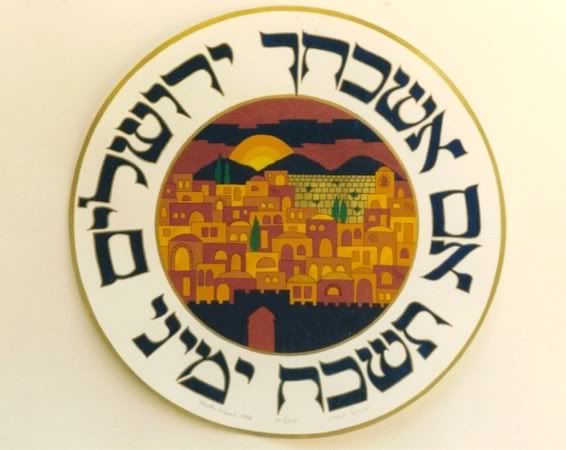
I don't know when I'll be able to post again but I wanted to share with you the picture of the Ketuba. It was made by Rosie Weisel of Kibbutz Sa'ad, she was my Kibbutz Mom while I was living there.


If you can't read the Possuk on top here it is:
My soul yearns, yea, it pines for the courts of the Lord; my heart and my flesh pray fervently to the living God.
Psalms 84:3
There's a couple connections between our names Naomi Liba and Natan Chai within the possuk, I don't remember them all but Rosie was very excited while explaining it to me. Besides the Sheva Minim and the Beit HaMikdash there are two pictures in the Ketuba with meaning for us. The top flowers on either side are alstroemeria which Naomi chose for the wedding. On the bottom left is the dugma for the wedding. It is two Nun's creating a candlestick and a Fey that becomes the flame of the candle for the last name.

Anyway, I hope to post again sometime next week but I will not promise anything.

Sunday, January 07, 2007

It's been One Week...

As ADDeRabbi mentioned, he is the Mesader Kedushin at my upcoming wedding. I've made very few comments about the wedding on the blog because I started the blog after we were engaged and until now there hasn't been anything all that important. (For those keeping track we've been engaged for 13 months - please don't let your own engagement last longer that 6 months).

Since the wedding is this coming Sunday, Naomi and I will not be seeing/speaking/IMing/whatevering until the Bedeken. I will take this oportunity to mention that there is no halachic basis for this minhag.

Two of my Rebbeim have debated this minhag, Rav Blau saying "there's no basis and I didn't do it" while Rav Brovender says "It's nice". I seem to fall somewhere in the middle on this issue. I feel no compulsion to follow it, but it is nice. Especially since Naomi deems it necessary here I am talking to the computer. I thought I had a copy of this shiur on my computer but unfortunately I do not, if I can find it I'll post it. It's quite funny, two giants of Torah debating such a seemingly silly topic.

I hope this week goes by quickly.

Thursday, January 04, 2007

Gan Eden and Olam HaBa: Immortality and Omniscience

Back in April I wrote a post entitled Adam and Eve: Is Gan Eden Really Our Goal? I argued that the planting of the two trees inside the garden and the subsequent eating of the Etz HaDa'at Tov u'Ra was equal to the choosing of knowledge over life. And thus when God expels Adam and Chava from the garden they are forced to remember how tough life is an eternal remembrance of that choice.

I'd like to revisit that discussion.
God purposely planted the Paradise for man, who was called upon to cultivate and guard it. Man is encouraged to build, to plant, to beautify his life, to enjoy his life as much as he can. 'And the Lord God planted a garden eastward, in Eden, and there He placed man whom He had formed; and the Lord God made grow out of the ground every tree delightful to the eye and good for food...' (Gen. 2:8-9). But two horrible fears haunt man steadily, trailing him like an everlasting shadow: the fear of nihility, of nonbeing - death - and the fear of ignorance. Man wants to live and to know. He is eager to lead an intelligent, enlightened, inextinguishable existence. His greatest aspiration, his most fascinating dream is to defeat death and to grasp the mysterium magnum, the great mystery of creation. God did plant the garden with trees pleasant to look at and delightful as far as taste is concerned. And in the middle of the garden grew the two mysterious trees representing the two basic aspirations of man: to live and to know. Yes, God planted the garden in Eden in order to place there the man whom He formed, for man is entitled to desire, to quest, to long for and be fascinated by something great and wonderful - immortality and omniscience.

Rav Joseph B. Soloveitchik Family Redeemed p. 10-11
The Rav would have likely amended my conclusion by stating that God was punishing Adam and Eve not because she ate of the tree - it was only a manifestation of the desire for immortality and omniscience - but rather because she chose one of those desires over the other. We live in a world where immortality is out of our reach, we will never be able to find that "Fountain of Youth" to give us immortality. Likewise, we will never be omniscient. Despite our best efforts to record all of human intelligence - as the encyclopedia was originally intended by the French after the French Revolution of 1789 and wikipedia - we will never be omniscient.

An interesting side point: How does this fit in with the Rambam? Rambam realized that there can never again be the combination of immortality and omniscience as there was in Gan Eden. In describing Olam HaBa he speaks about the immortality of the mind because - well for one thing, his Aristotelian foundation - but also because he cannot fathom that Gan Eden was anything more than a dream. I believe that the Rambam would argue - not that creation did not happen - but rather that Gan Eden was not the earth that we understand. It was not a physical place, you cannot go to the spot where it was. Omniscience, by definition for the Rambam, excludes a physical body because God is omniscient and if/when people become omniscient we cannot have a body either.

I'd like to point out that I don't believe that the Rambam would suggest that the human mind could, in Olam HaBa, achieve the same omniscience that God has, but rather that during our lives we strive for that goal. We do everything we can to achieve that omniscience because we have an eternal desire for what was lost in Gan Eden - immortality and omniscience.

Wednesday, January 03, 2007

Hasidic Police Officer Joel Witriol

I'm sure many of you have heard that NYPD graduated its first Hasidic Police Officer, Joel Witriol, this past month. I, like many of you, read about it - said "cool" - and moved on to more important stories than your run-of-the-mill human interest story. That was until New Years Eve.

As my sister and I were traveling to a concert at Radio City Music Hall (great place to see a show), we got off the C line at 50th and 8th Ave. It turns out that 50th was blocked off and the Police there told us to walk to 52nd and cross. At 51st we over heard the Officer telling people that only those with tickets could cross. I didn't know what tickets they wanted, but we had two so I flashed them and through the barricade we went - crossing 5 more until we came to 6th Ave.

As we crossed the barricade I noticed that the Police Officer standing next to me had peot tucked behind his ears. I glanced quickly to see the name tag and it read "Witriol". I told Bethany (my sister) to wait a minute as I got inline to speak to him. Finally my time came.

He noticed my kippah, but didn't mention anything. I asked him if he had just graduated - he responded yes - then I said "You're the one that I read about in the papers?" "Yes". "Awesome, great job." To which he said "Thanks". And I walked away.

I really should have mentioned how great of a Kiddush Hashem he was doing and that despite the fact that many people disaprove of his profession there are those of us frum yidden who care. I didn't know at the time that it was his first duty assignment either - he looked spiffy in his brand new Police uniform and (blue PO) hat.

Joel, wherever you are, sh'koyach and keep up the good work.

Monday, December 18, 2006

The "Real" Miracle of Chanukah?

I went back to UMD this past Shabbat and the student who gave the D'var Torah at Shalosh Shiddus asked an important question: "Why in all of the nessim of Chanukah do we commemorate the event by lighting a menorah?" His answer, which came after some proofs, is that by acknowledging a small nes it allows us to appreciate the larger ones more.

Unfortunately I don't know his name, but I think he's right on target.

Rav Shlomo Aviner points out that when there's no Shemen Tahor it is possible to light the menorah with Shemen Tameia. When Rov Am Yisrael is Tamei it is still possible to bring the Korban Pesach and to build the Temple. The same din is applied when there's no Shemen Tahor; it is mutar to light the menorah with Shemen Tameia because it's a communal activity. (Tal Hermon vol. 2 p. 85)

So, if there is the case, why the big deal about finding a flask of pure oil and, more importantly, why did HaShem deem it necessary to make it last for eight days? Rambam tells us that this is how long it takes to produce Shemen Tahor, but why does any of this matter if they can use the Shemen Tameia instead? Why the נס פך השמן?

I think the answer comes back to the student's original question. "Why in all of the nessim of Chanukah do we commemorate the event by lighting a menorah?" It is the seeming triviality of the nes that makes it important. The Jews in the Temple went out of their way to find the Shemen Tahor and their actions were rewarded with a nes.

If this idea is accurate then HaShem davka made the נס פך השמן so that we would appreciate the Chag more. Instead finding us celebrating the נס הניצחון הצבאי in some other way, we are found at home bringing light into the world with our families.

Chag Orim Sameach

Sunday, December 10, 2006

On the Bus Beating

ADDeRabbi and Harry have posted great comments on the recent Bus Beating. I don't think she was doing - as Harry termed it - a Rosa Parks style sit-in. First off, she wasn't doing anything contrary to the signs on the bus. Rosa was a hero, this woman did even more.

I am copying the comments I left on Harry's post because I feel very strongly that this needs to be spread to as many people as possible so that the outrage becomes known; to hopefully prevent this Chillul HaShem from ever happening again.

There are many comments in this thread that as an Orthodox Jew I find truly disturbing. It is no wonder that the Chiloni world hates Charedim so much. For all of the Ahavas Yisroel that we're supposed to have we can't even treat a woman - who may or may not be in the wrong -with simple Kavod HaBrios. Explain to her why the community has the feelings it does, talk to her. Treat her with dignity - she'll listen.

Egged is not a Halachic company - it is however a company that will abide by Halacha if the community demands it. If the bus wasn't a Mehadrin bus then it wasn't a Mehadrin bus and the Community obviously doesn't care enough to go through the process of getting it fixed.

That's the end of the story. Whatever wrong she did shouldn't even be discussed; the community has decided it doesn't care enough to prevent something like this from happening.

Friday, December 08, 2006

On the CJLS decision

I received an e-mail from a commenter asking me about my opinion regarding the recent CJLS decision to permit Homosexual marriages and Rabbinic Ordination. So I'll try to take a stab at it:

In my opinion the CJLS has reniged on it's charter - that to be the Halachic deciding body of the Conservative Movement - there is absolutely no way (as Joel Roth's tshuva said) to allow this al pi HaHalacha. As a self-described Halachic movement, I fail to see how they could allow this.

I have been told by a Conservative Rabbi (she's the mother of a friend) that this decision - in April she knew it'd pass - had less to do with Halacha than it does with trying to save the population slide within the Movement. While I think that has a lot to do with the decision, it still does not make sense; the long term survival of the movement does not need to permit this.

Two of my former roommates are currently at JTS now. While they disagree to the level that Homosexuals should be active within the Movement, they both agreed that it was absolutely the right thing to do and nearly 90% of the Student population agreed. It bothers me, that the students at JTS believe that driving on Shabbat is assur yet Homosexual marriage and ordination (let alone the Homosexual act) should be permitted by Halacha.

As you may have read, Roth and Rabinowitz - two of the major forces within the CJLS - have both resigned following the decision. I fully support their decision. Elliot Dorff, one of the authors of the decision to allow Homosexual marriage and ordination, said “Celibacy is a cruel option.” If it is cruel we still must be aware that the Torah demands it. We cannot pretend that it does not.

I will take this opportunity to post a quote from an article that I read regarding the Gay Pride Parade in Jerusalem.
Judaism looks negatively at homosexual activity, but not at the homosexual nature, whether it is genetic or acquired (the Torah does not express any view on the matter), is immaterial. This nature in no way diminishes or affects the Jewishness of a homosexual. He is as beloved in G-d's eyes as any other Jew, and is as responable as any Jew in all the mitzvos. He is obligated to achieve life's goals by directing his life towards spiritual growth, sanctity and perfection of his character - no less than is any other Jew. He will merit the same share in the World to Come which every Jew merits, minimally by being the descendant of Avraham Avinu and maximally by totally devoting his life towards the service of G-d.

Rav Aharon Feldman (quoted by Rabbi Moshe Hauer in "Horror, Sadness, and Concern" in the Baltimore Jewish News 11/24/06)
I think this is the proper response to the issue. This is where the joke Im tirtzu ain zo Halacha - If there's a Rabbinic Will there's a Haalchic way ends. There is no way to change the Torah and two thousand years of Rabbinic legislation.

Tuesday, November 28, 2006

Two Men and a Movie

It's been a tradition in my family for quite some time now that we all go catch a matinée on the Friday after Thanksgiving. When we were younger it was always whatever new Disney movie was out, but this year we went to see Bobby. If you haven't heard, Bobby is Emilio Estevez's new movie about the assassination of Bobby Kennedy in 1968.

The reason that I bring all of this up is that it's a fantastic movie. Unlike most movies about a single event, Bobby is focused on 22 characters who are in the Ambassador Hotel on that day. There are politicians, a young couple on the day of their wedding, superstars, cooks, and managers. But the overall theme, and Estevez was particularly good at getting this across, was what Bobby Kennedy meant to people in 1968 - the hope that he promised.

I could not but help think at the end of the movie that there really needs to be a movie about Yitzhak Rabin made in a similar format. When Rabin was assassinated twelve years ago I was too young to understand his politics, but I saw the look on my mother's face when we heard that he had died. I do not agree with Rabin's politics - and neither did my mother - but on that day, as in 1968, the hope was killed a long with the person. I'm not totally sure that it can be regained either, well not very easily at least.

Do yourself a favor, go see Bobby.

Tuesday, November 21, 2006

David Brown goes back to work

Thanks to the enormous outpouring of support for David, Towson University reached an agreement with him to allow him to return to work as a University Police Officer. If you don't live in the Baltimore/DC area you probably haven't heard about him, and if you do I'd be shocked if you haven't.

David Brown has been in the Jewish Times, Campus Newspapers, Local TV, and on the radio. The Jewish community put aside their differences and came out and supported him and forced Towson to rethink their strategy.

Here's the Baltimore Sun's article:
But while Brown was celebrating the Sabbath, he was also missing shifts with the Towson University police department. In a dispute that inspired protests and petitions from students, Brown accused the school of religious discrimination, while the school suspended him from his job.

Yesterday, a day before a hearing that Brown feared would have led to his termination, he reached an agreement with the university. Although supervisors will still assign Brown to work during the Sabbath, they will give him more freedom to find other officers to cover his shifts, and even allow him to skip some.
Towson is allowed to save face though Brown does not get everything he wanted and deserved it's still a win in his eyes. It's times like these when I see communal support that books like Jew Vs. Jew are not 100% accurate. Jews are still - despite their religious, political, philosophical differences - Jews, willing to help each other out when it's necessary.