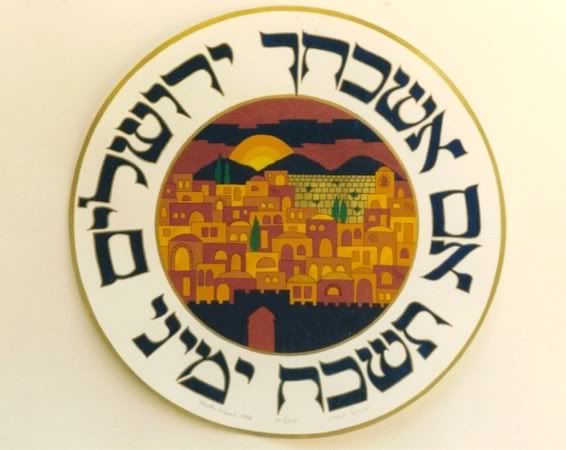
Tonight is erev Tisha B'Av. It's always been a very hard day for me; to understand the imagery that we find in Eicha. Two years ago I sat at the Kotel all day trying to feel the destruction - but I can't - it's so much easier for me to feel the destruction of the nation through the Holocaust, the descriptions provided in the megillah of what the populace went through during the siege. This is why most shuls watch Holocaust movies - because we cannot connect to the Temple - despite our best efforts most of us cannot do it.
XGH says that this phenomenon is proof that we don't really want the Temple back; I don't think so, it's been 2,000 hard years and we - today's Jews - don't really get it. So we take other aspects of Tisha B'Av the other calamities that have befallen us on this day and connect to those.
Is it bad to do so? No, I don't think so, since it's also an integral part of the day. But this year I'm going to make a concerted effort - like I've done in the past - to think about the Avoda in the Beit HaMikdash and what the Churban really was.
I found RWAC's post to be truly moving, because I feel that I will come out of Tisha B'Av feeling very like that. Today I will accept God's judgment, but I'm moving to Israel in a week. I have the pain of packing and moving boxes in my arms and legs; I can't forget that. There is a day after Tisha B'Av and on Tu B'Av I will move to Israel.
This year's Tisha B'Av promises to not be the average Tisha B'Av. It will be hard and special in it's own way.
Showing posts with label Hashkafa. Show all posts
Showing posts with label Hashkafa. Show all posts
Monday, July 23, 2007

Tuesday, May 22, 2007
Halacha vs. Kabbala
I found a shiur given by R' David Fink rather enlightening and decided to share it hear. Nothing that follows is my own idea, only Rav Fink's. The original shiur can be heard here. As I only heard the shiur online I do not have any source notes unless Rav Fink said them.
What happens when Kabbala and Halacha tell you to do two different things?
The Tur: Put on Teffilin shel Yad and Barech (l'haniach tefillin), then shel Rosh and make a second Beracha (al mitzvat tefillin).
R' Yosef Karo not only wrote the Beit Yosef and the Shulchan Aruch but was also a noted Kabbalist. He lived in Sfat during the time of the AriZal - in fact, he was his neighbor - and is the author of the Magid Meisharim. This work is a compilation of statements made by R' Karo while in a trance and a Magid spoke through R' Karo. There are times that the Magid and the R' Karo disagreed with each other. Of couse, R' Karo poskens in the Beit Yosef against the Magid. R' Yaakov Emden assumes this because R' Karo was a greater talmid chacham than the magid.
Rav Fink has heard of authors of fiction expressing similar methods. They go into a trance and the characters in the book speak to them and they authors write down the dialogue as they hear it in their minds. Unfortunately this gift is never given to writers of non-fiction. These authors have to work out their solutions rationally unlike the fiction authors that just let it flow.
The halachic R' Karo depended on his reason when writing the Shulchan Aruch, the mystical R' Karo reported his mystical periods in the Magid Meisharim. Whenever there is tension for R' Karo halacha is in accord with the rational reasoning in the Beit Yosef as poskened in the Shulchan Aruch.
Back to the Berachot of Tefillin:
Sefer HaAgur: I found in the Zohar from a saying of Rashbi - a single beracha is to be said on both tefillin together. The teffilin shel rosh on the head correspond to Zachor and teffilin shel yad next to the heart correspond to Shamor. Just as we say Shamor and Zachor were said together at Matan Torah a single beracha covers both tefillin. One should not wait between the two tefillin, one should do both without a hefshek. I am amazed that these great Rabbanim disagree with Rashbi in the Zohar, if the Poskim knew what was said in the Zohar, why did they disagree with it? In any case, the minhag is to make two beracha, but the right thing to do is to make one beracha.
R' Karo: I don't know why the Sefer HaAgur was mystified on this question. There are plenty of other examples between the gemara and the zohar, why is it this one that he's so interested in? In every case the poskim follow the gemara and never the zohar. Even if the poskim knew the zohar they wouldn't care - the reason the poskim say to make two berachot is because that's what it says in the Gemara. All the more so, in the days of the Reshonim the Sefer HaZohar was not yet known. It was transmitted it Rebbe to Talmid for generations and only surfaced published much later. Furthermore, the passage in the Zohar (quoted by the Sefer HaAgur) does not necessarily mean only to make one beracha for both tefillin. What it might mean is that the first beracha applies to both teffilin and therefore one should not interrupt between them, the teffilin shel rosh needs its own beracha. Bottom line - two berachot on Tefillin regardless of what the Zohar says.
We see here one clear example where we follow the Gemara and the Poskim regardless of the Zohar.
The Magen Avraham was the first of the great poskim to systematically apply kabbalistic sources in his halachic discussion. Previous to him people related to the Zohar as a body of matterial that explained to us the inner workings of Torah, the world, and the universe we live him. A philosophical insight into the world. He was therefore bothered between the tension between the Zohar and the Halachic material. He quoted the the Kenesset HaGedola: wherever theres a conflict between the kabbala and the halacha - the halacha is always in accordance with the poskim. He seems to be referring to a situation where all the poskim are on one side and the zohar is on the other side. If the kabbalists are stricter than what is required by the poskim we can be machmir like the kabbalists. any issue that is not mentioned in the poskim - no source in the gemara but does in the zohar - we have no authority to impose the practice upon the people. Only halacha can be forced upon the people, we can try to convince people to follow the kabbalistic method but that's it.
Sometimes people asked R' Moshe Feinstein what is the meaning or reason why so and so poskend this way found in other places. Someone asked R' Feinstein (found in the Iggrot Moshe) why did the Mishna Berurah posken that one who stays awake all night without sleep that he does not make the berachot Bircat haTorah etc.. Whenever there is a machloket amongst poskim and the weight of the Zohar and Kabbalists determine the outcome. In this case the Mishna Berurah should have followed the AriZal to make the beracha. So why did he reject this position? Answer: It's obvious that the idea that the Kabbalists always prevail wherever there is a machloket amongst the poskim that idea only pertains to material in the zohar itself - that prevails. Why? That material comes from the time of the Mishnah. But the works of the later Kabbalists - the AriZal and others - does not have the same weight of the Zoharic literature. Therefore one can poskin the AriZal just like one can poskin against one other posek.
Rav Fink finds it mysterious: The Iggrot Moshe speaks with a very clear voice. He never applies this above rule not even once.
The Chacham Zvi (who was a great Kabbalist in addition to being a noted Posek) when speaking about the Machloket about how one should position his bed (Kabbalists Head West / Feet East vs. Poskim Head North / Feet South) says in a situation where the Zohar is opposed to the Gemara and Poskim - we never abandon the poskim in favor of the position of the Zohar. When in comes to Halacha we ignore the Zohar and rely on the Poskim. However, in a situation where the Poskim are divided it is correct (note: he does say must) to follow the Kabbala.
His son, R' Yaakov Emden, even though he denied the antiquity of the zohar in Mitpachat Sefarim, was a major Kabbalist. I remember that my father zt"l lived across the street from the non-Jewish orphanage; his bed was oriented like the mekubalim say and not like the poskim. He himself wrote one should follow the poskim and not the kabbalah, but I saw in practice he did the opposite from what he wrote. In order for there to be a machloket people need to be in each others presence, it is improper to say two people who are unaware of each others opinion it is not proper to call this a machloket. Did the poskim know the words of the Zohar becasue it was being transmitted secretly and these poskim are outside of the chain of tradition. Perhaps they would have changed their mind had they known. We should not be concerned that we reject mystical ideas in Halacha - elu v'elu divrei elokim chaim. [R'
How does this come down in the more recent poskim?
The Munkatcher Rav (R' Elazar Shapira) - a noted posek and mekubal - it's important to bear in mind the difference between nigleh and nistar (revealed and secret wisdom). When I study the Zohar and words of the great Kabbalists I think of myself as learning nigleh - revealed wisdom. When I study Gemara, the Rambam, the Tur, and the Shulchan Aruch I think of myself as learning nistar - the secret wisdom of Torah. The works of the kabbalists talk about Olam HaSefirot they say they talk about the mystical reality of Sefirot and they are. The Halchic literature does not say they are talking about the mystical reality but indeed they are this is why I call them Nistar - hidden.
The Shulchan Aruch HaRav - whenever there is a disagreement between the kabbalits and the poskim - you should posken like the gemara and the poskim. Make two berachot on tefillin. The Baal HaTanya accepts the position of the Magen Avraham , we can require people to follow the gemara and no the Zohar. Halacha and Halachic sources always prevail over the Zohar and Kabbalistic sources.
Rav Fink notes that Chabad Chassidim do not follow this position. In every conflict between the Gemara and the Zohar they follow the Zohar instead of the ruling of the Baal HaTanya and make one beracha on tefilin. The Shaar HaKollel - R' Avram David Livat - I heard from a Chasid before he died that the Baal HaTanya had been asked about this question. Our minhag is to follow the Mekubalim instead of the poskim. Why then did you write in Shulchan Aruch HaRav to follow the poskim? I only wrote that because the poskim write to follow the poskim, but the mekubalim all write to follow the Zohar. It cannot be that the mekubalim would not follow the gemara and therefore the question doesn't make sense. This is what I heard from that Chasid before he died.
This is a tradition starting three generations after the Baal HaTanya. This is the reason the Baal HaTanya started to write a second edition of the Shulchan Aruch HaRav but only got a few pages in where he surely would have poskened like the mekubalim against the poskim.
Rav Fink: We find many stories (folk literature) that a major posek changed his mind on their deathbed. These stories are possibly true and it surely does happen and I doubt that it happens every time it is reported.
The traditions of the Gra weigh heavily on the Aruch HaShulchan and writes: When there is a machloket between the Zohar and the Poskim we of course follow the Poskim. It is correct to be machmir like the Zohar when they are machmir. One cannot require one to follow the Zohar. I have a tradition (from the Gra) that is impossible that there is a true conflict between the Gemara and the Zohar unless of course there are multiple opinions in the Gemara and the Zohar is holding like one opinion there. People have an incorrect understanding of the Zohar if they think there is a machloket between them
Thursday, January 04, 2007
Gan Eden and Olam HaBa: Immortality and Omniscience
Back in April I wrote a post entitled Adam and Eve: Is Gan Eden Really Our Goal? I argued that the planting of the two trees inside the garden and the subsequent eating of the Etz HaDa'at Tov u'Ra was equal to the choosing of knowledge over life. And thus when God expels Adam and Chava from the garden they are forced to remember how tough life is an eternal remembrance of that choice.
I'd like to revisit that discussion.
An interesting side point: How does this fit in with the Rambam? Rambam realized that there can never again be the combination of immortality and omniscience as there was in Gan Eden. In describing Olam HaBa he speaks about the immortality of the mind because - well for one thing, his Aristotelian foundation - but also because he cannot fathom that Gan Eden was anything more than a dream. I believe that the Rambam would argue - not that creation did not happen - but rather that Gan Eden was not the earth that we understand. It was not a physical place, you cannot go to the spot where it was. Omniscience, by definition for the Rambam, excludes a physical body because God is omniscient and if/when people become omniscient we cannot have a body either.
I'd like to point out that I don't believe that the Rambam would suggest that the human mind could, in Olam HaBa, achieve the same omniscience that God has, but rather that during our lives we strive for that goal. We do everything we can to achieve that omniscience because we have an eternal desire for what was lost in Gan Eden - immortality and omniscience.
I'd like to revisit that discussion.
God purposely planted the Paradise for man, who was called upon to cultivate and guard it. Man is encouraged to build, to plant, to beautify his life, to enjoy his life as much as he can. 'And the Lord God planted a garden eastward, in Eden, and there He placed man whom He had formed; and the Lord God made grow out of the ground every tree delightful to the eye and good for food...' (Gen. 2:8-9). But two horrible fears haunt man steadily, trailing him like an everlasting shadow: the fear of nihility, of nonbeing - death - and the fear of ignorance. Man wants to live and to know. He is eager to lead an intelligent, enlightened, inextinguishable existence. His greatest aspiration, his most fascinating dream is to defeat death and to grasp the mysterium magnum, the great mystery of creation. God did plant the garden with trees pleasant to look at and delightful as far as taste is concerned. And in the middle of the garden grew the two mysterious trees representing the two basic aspirations of man: to live and to know. Yes, God planted the garden in Eden in order to place there the man whom He formed, for man is entitled to desire, to quest, to long for and be fascinated by something great and wonderful - immortality and omniscience.The Rav would have likely amended my conclusion by stating that God was punishing Adam and Eve not because she ate of the tree - it was only a manifestation of the desire for immortality and omniscience - but rather because she chose one of those desires over the other. We live in a world where immortality is out of our reach, we will never be able to find that "Fountain of Youth" to give us immortality. Likewise, we will never be omniscient. Despite our best efforts to record all of human intelligence - as the encyclopedia was originally intended by the French after the French Revolution of 1789 and wikipedia - we will never be omniscient.
Rav Joseph B. Soloveitchik Family Redeemed p. 10-11
An interesting side point: How does this fit in with the Rambam? Rambam realized that there can never again be the combination of immortality and omniscience as there was in Gan Eden. In describing Olam HaBa he speaks about the immortality of the mind because - well for one thing, his Aristotelian foundation - but also because he cannot fathom that Gan Eden was anything more than a dream. I believe that the Rambam would argue - not that creation did not happen - but rather that Gan Eden was not the earth that we understand. It was not a physical place, you cannot go to the spot where it was. Omniscience, by definition for the Rambam, excludes a physical body because God is omniscient and if/when people become omniscient we cannot have a body either.
I'd like to point out that I don't believe that the Rambam would suggest that the human mind could, in Olam HaBa, achieve the same omniscience that God has, but rather that during our lives we strive for that goal. We do everything we can to achieve that omniscience because we have an eternal desire for what was lost in Gan Eden - immortality and omniscience.
Monday, December 18, 2006
The "Real" Miracle of Chanukah?
I went back to UMD this past Shabbat and the student who gave the D'var Torah at Shalosh Shiddus asked an important question: "Why in all of the nessim of Chanukah do we commemorate the event by lighting a menorah?" His answer, which came after some proofs, is that by acknowledging a small nes it allows us to appreciate the larger ones more.
Unfortunately I don't know his name, but I think he's right on target.
Rav Shlomo Aviner points out that when there's no Shemen Tahor it is possible to light the menorah with Shemen Tameia. When Rov Am Yisrael is Tamei it is still possible to bring the Korban Pesach and to build the Temple. The same din is applied when there's no Shemen Tahor; it is mutar to light the menorah with Shemen Tameia because it's a communal activity. (Tal Hermon vol. 2 p. 85)
So, if there is the case, why the big deal about finding a flask of pure oil and, more importantly, why did HaShem deem it necessary to make it last for eight days? Rambam tells us that this is how long it takes to produce Shemen Tahor, but why does any of this matter if they can use the Shemen Tameia instead? Why the נס פך השמן?
I think the answer comes back to the student's original question. "Why in all of the nessim of Chanukah do we commemorate the event by lighting a menorah?" It is the seeming triviality of the nes that makes it important. The Jews in the Temple went out of their way to find the Shemen Tahor and their actions were rewarded with a nes.
If this idea is accurate then HaShem davka made the נס פך השמן so that we would appreciate the Chag more. Instead finding us celebrating the נס הניצחון הצבאי in some other way, we are found at home bringing light into the world with our families.
Chag Orim Sameach
Unfortunately I don't know his name, but I think he's right on target.
Rav Shlomo Aviner points out that when there's no Shemen Tahor it is possible to light the menorah with Shemen Tameia. When Rov Am Yisrael is Tamei it is still possible to bring the Korban Pesach and to build the Temple. The same din is applied when there's no Shemen Tahor; it is mutar to light the menorah with Shemen Tameia because it's a communal activity. (Tal Hermon vol. 2 p. 85)
So, if there is the case, why the big deal about finding a flask of pure oil and, more importantly, why did HaShem deem it necessary to make it last for eight days? Rambam tells us that this is how long it takes to produce Shemen Tahor, but why does any of this matter if they can use the Shemen Tameia instead? Why the נס פך השמן?
I think the answer comes back to the student's original question. "Why in all of the nessim of Chanukah do we commemorate the event by lighting a menorah?" It is the seeming triviality of the nes that makes it important. The Jews in the Temple went out of their way to find the Shemen Tahor and their actions were rewarded with a nes.
If this idea is accurate then HaShem davka made the נס פך השמן so that we would appreciate the Chag more. Instead finding us celebrating the נס הניצחון הצבאי in some other way, we are found at home bringing light into the world with our families.
Chag Orim Sameach
Friday, October 27, 2006
The Conservative Movement and Homosexuality
In March the Committee for Jewish Laws and Standards (CJLS) of the Conservative Movement postponed their decision on the allowance of Homosexuality in the movement to December. I posted a few times previously regarding my feelings on the issue (here, here, and here).
In deference to a few former roommates and friends that currently attend JTS (one of whom is a very outspoken supporter of the proposal) I try to be as civil as I can. In short I think the issue is very clear: accepting Gays and Lesbians into Rabbinic positions is tantamount to rewriting the Torah.
I re-stumbled across KeshetJTS's website (the Pro-Gay group at JTS) and noticed this article entitled: Does the Old Testament Really Condemn Homosexuality? by Rabbi Michele Brand Medwin of Binghamton, NY.
Quoting the obvious psukim (Vayikra 18:22 etc.) she looks at how the word Toeva (abhorrence) is used in other contexts. They all seem to deal with Avoda Zara. Since, she concludes, "Homosexuality was used as a pagan ritual. God was not condemning the act of homosexuality itself. God was condemning the pagan ritual act of homosexuality and all that is associated with it." But the homosexual act is actually allowed according to Brand.
"In today’s world this prohibition now has no meaning. We are no longer threatened by Canaanite pagan religion and homosexuality today is not a pagan ritual. Homosexuality in Biblical terms is no longer an issue for us today."
I'm sure it's clear that I think she's completely off base here, but this has always been the problem of finding Ta'amei HaMitzvot (reasons for the commandments) - once you "find" the reason, if it no longer applies then what good is it? As was pointed out to me once (maybe in the name of Rav Hirsch) that Ta'amei Hamitzvot really should be translated as flavors of the Commandments. Instead of trying to figure out what God was commanding this for, we've come to understand what the mitzvah means to us. A subtle but importance difference.
Rabbi Brand believes she's figured it all out, and in only four pages too, something that no other Torah scholar in the previous three thousand plus years has been able to do either. Sorry for the sarcasm, but I don't know how else to react.
In deference to a few former roommates and friends that currently attend JTS (one of whom is a very outspoken supporter of the proposal) I try to be as civil as I can. In short I think the issue is very clear: accepting Gays and Lesbians into Rabbinic positions is tantamount to rewriting the Torah.
I re-stumbled across KeshetJTS's website (the Pro-Gay group at JTS) and noticed this article entitled: Does the Old Testament Really Condemn Homosexuality? by Rabbi Michele Brand Medwin of Binghamton, NY.
Quoting the obvious psukim (Vayikra 18:22 etc.) she looks at how the word Toeva (abhorrence) is used in other contexts. They all seem to deal with Avoda Zara. Since, she concludes, "Homosexuality was used as a pagan ritual. God was not condemning the act of homosexuality itself. God was condemning the pagan ritual act of homosexuality and all that is associated with it." But the homosexual act is actually allowed according to Brand.
"In today’s world this prohibition now has no meaning. We are no longer threatened by Canaanite pagan religion and homosexuality today is not a pagan ritual. Homosexuality in Biblical terms is no longer an issue for us today."
I'm sure it's clear that I think she's completely off base here, but this has always been the problem of finding Ta'amei HaMitzvot (reasons for the commandments) - once you "find" the reason, if it no longer applies then what good is it? As was pointed out to me once (maybe in the name of Rav Hirsch) that Ta'amei Hamitzvot really should be translated as flavors of the Commandments. Instead of trying to figure out what God was commanding this for, we've come to understand what the mitzvah means to us. A subtle but importance difference.
Rabbi Brand believes she's figured it all out, and in only four pages too, something that no other Torah scholar in the previous three thousand plus years has been able to do either. Sorry for the sarcasm, but I don't know how else to react.
Tuesday, August 15, 2006
Creationism Explained by Soda and Bananas
Watch the video first:
If that is the basis of belief in Creationism or God in general I'm going to cry. It's not only sad that people believe people like these two - but enough people believe it that they make a TV show about it. I also found it interesting that William Paley's famous watchmaker proof (If you find a watch in the desert there must have been a watchmaker...) is re-invented to soda. And yes, that's Kirk Cameron of Growing Pains (and brother to Candice Cameron of Full House).
If that is the basis of belief in Creationism or God in general I'm going to cry. It's not only sad that people believe people like these two - but enough people believe it that they make a TV show about it. I also found it interesting that William Paley's famous watchmaker proof (If you find a watch in the desert there must have been a watchmaker...) is re-invented to soda. And yes, that's Kirk Cameron of Growing Pains (and brother to Candice Cameron of Full House).
Monday, June 05, 2006
On Documentary Hypothesis
Documentary Hypothesis has been the topic of conversation on some major blogs of late. So when the following quote caught my eye I thought it should be posted.
This book was given to me by a good friend and I found the above quote to be rather astute for a non-religious insight. I do not know the author, though a guest for a Shabbos lunch knew quite a lot about Kass (the guest's brother apparently works with Kass and speaks quite highly about him). I'm quite interested in what Kass has to say about Bereshit, I'm sure I'll blog about it in the future.
...The academic study of the Bible has raised major methodological questions, not least about whether the Bible - and even the single book of Genesis - is in fact a coherent and integral whole. The so-called documentary hypothesis argues that what we call the Bible is in fact a latter-day compilation of disparate materials, written by different authors at different times, having different outlooks and intentions, even employing different concepts of and names or God. But even granting that the material compiled in Genesis came, to begin with, from different sources, one must still consider what intention or idea of wholeness governed the act of compilation that produced the present text. Must one assume that the redactor was some pious fool who slavishly stitched together all the available disparate stories without rhyme or reason, heedless of the contradictions between them? Or should we not rather give the redactor the benefit of the doubt and assume that he knew precisely what he was about? Could he perhaps have deliberately juxtaposed contradictory stories to enable us to discover certain contradictory aspects of the world thereby made plain? True, finding a coherent interpretation of the whole does not guarantee that one has found the biblical author's (or redactor's) own intention. But it should give pause to those who claim that the text could have no such unity. Besides, knowing the historical origins or sources of the text is not substitute for learning its meaning; to discover the meaning, a text must be studied in its own terms.Leon R. Kass The Beginning of Wisdom: Reading Genesis. p. 13-14.
This book was given to me by a good friend and I found the above quote to be rather astute for a non-religious insight. I do not know the author, though a guest for a Shabbos lunch knew quite a lot about Kass (the guest's brother apparently works with Kass and speaks quite highly about him). I'm quite interested in what Kass has to say about Bereshit, I'm sure I'll blog about it in the future.
Tuesday, May 30, 2006
I too am a Lonely Man of Faith
Doubleday has recently published Rav Soloveitchik's classic work Lonely Man of Faith (it may be the best $10 you'll ever spend). I haven't read the work in years and I'm only just starting it again, but I'm reminded of a topic that I think is really important.
Soloveitchik believes that people of faith are alone in the modern world; that contemporary society forces people who believe to feel like outsiders. Modern academic scholarship is foreign to the faithful.
It reminds me of a conversation I had with Steg's brother. Jews are different. Jews have a different set of dilemmas than the rest of humanity does. Philosophic and moral issues for the rest of the world just aren't for Jews. Maybe that's because our tradition has dealt with these issues previously (i.e., Talmud) but I believe it to be more of akin to a separate reality. Our issues revolve around relating to HaShem, Halachik requirements and Bein adam l'chavero issues.
As Soloveitchik writes:
Other things may, but not this.
Soloveitchik believes that people of faith are alone in the modern world; that contemporary society forces people who believe to feel like outsiders. Modern academic scholarship is foreign to the faithful.
It reminds me of a conversation I had with Steg's brother. Jews are different. Jews have a different set of dilemmas than the rest of humanity does. Philosophic and moral issues for the rest of the world just aren't for Jews. Maybe that's because our tradition has dealt with these issues previously (i.e., Talmud) but I believe it to be more of akin to a separate reality. Our issues revolve around relating to HaShem, Halachik requirements and Bein adam l'chavero issues.
As Soloveitchik writes:
These are the things that do not bother the Rav, some of them bother me, some of them don't. Some may bother you, some may not. What is important is the overall message, what secular society deems important just isn't for the faithful. Even if Richard Elliot Freedman is correct, even if Spinoza is, it does not really affect me. I find it interesting, but they do not trouble my faith.I have never been seriously troubled by the problem of the Biblical doctrine of creation vis-à-vis the scientific story of evolution at both the cosmic and the organic levels, nor have I been perturbed by the confrontation of the mechanistic interpretation of the human mind with the Biblical spiritual concept of man. I have not been perplexed by the impossibility of fitting the mystery of revelation into the framework of historical empiricism. Moreover, I have not even been troubled by the theories of Biblical criticism which contradict the sanctity and integrity of the Scriptures rest. (p. 7)
Other things may, but not this.
Tuesday, May 09, 2006
Spinoza and the Hebrew Theocracy
In Chapter XVII of the Theologico-Political Treatise Spinoza argues that the original Hebrew Theocracy is nearly a perfect government. The election of Moshe to be the intermediary between the people and God is fundamentally, Spinoza claims, a decent way for society to be governed; they transferred power (the covenant) from God to Moshe to be the “sole promulgator and interpreter of the Divine laws”. When the people can be sure where the rules are coming from; there is no corruption in power.
What is really interesting is what Spinoza has to say about why the government collapsed. Chet HaEgel is fundamentally what brought down the Hebrew Theocracy; prior to that monumental event the priests were to be the bechorim spread evenly among the entire nation. Afterwards, the levi’im where chosen to be the priests as reward for their refusal to take part in the Chet HaEgel. The levi’im, according to Spinoza, became a bourgeois class; an envied group that ultimately grew to powerful and corrupted the State from the inside out. [This critique could have come from Hegel and Marx; which is probably one of the reasons why the Theologico-Political Treatise was one of the most popular books in Communist Russia.]
The final chapter of the TPT (or TTP in Latin) discusses what the proper government (Democracy) needs to be founded on. Spinoza, uses a critique of Moshe’s government to show how modern kings have faults:
Spinoza may have been a heretic, but he’s got some really interesting views on the Torah – he, at the very least, takes knowledge of Torah very seriously.
What is really interesting is what Spinoza has to say about why the government collapsed. Chet HaEgel is fundamentally what brought down the Hebrew Theocracy; prior to that monumental event the priests were to be the bechorim spread evenly among the entire nation. Afterwards, the levi’im where chosen to be the priests as reward for their refusal to take part in the Chet HaEgel. The levi’im, according to Spinoza, became a bourgeois class; an envied group that ultimately grew to powerful and corrupted the State from the inside out. [This critique could have come from Hegel and Marx; which is probably one of the reasons why the Theologico-Political Treatise was one of the most popular books in Communist Russia.]
The final chapter of the TPT (or TTP in Latin) discusses what the proper government (Democracy) needs to be founded on. Spinoza, uses a critique of Moshe’s government to show how modern kings have faults:
Moses, not by fraud, but by Divine virtue, gained such a hold over the popular judgment that he was accounted superhuman, and believed to speak and act through the inspiration of the Deity; nevertheless, even he could not escape murmurs and evil interpretations. How much less then can other monarchs avoid them!Even Moshe could not make a perfect government and he was really supported by God. In a backhanded way Spinoza’s making sure everyone knows that modern monarchies are not supported by God (they’ve got more issues than Moses’ did).
Spinoza may have been a heretic, but he’s got some really interesting views on the Torah – he, at the very least, takes knowledge of Torah very seriously.
Monday, May 01, 2006
Yom Ha'atzmaut and the Hitnatkut
With Yom Ha'atzmaut just around the bend I am curious how the Hitnatkut will change the way Israelis celebrate their Independence. Does the disengagement from Gaza change the way that Israelis relate to their state? On a political level, Israel is a democracy and citizens must accept the decisions of the state, even the ones they hate and move on. What about on a religious level? How does it feel to say reishit smichat geulateinu after being evicted from your home by the Israeli Army? Did the Hitnatkut change anything? For Rabbi Shear-Yashuv Cohen (Chief Rabbi of Haifa) has already started to publicly say: "Bless the State of Israel, so it will be the beginning of the flowering of our redemption."
This little semantic change has major implications, this isn't just a statement about Gush Katif, this is Israel has never been the "dawn of the redemption". Nothing Israel has done up till now, for R' Shear-Yashuv, has been part of the redemptive process. That a major theological statement. One that I don't think is shared by many of the Da'ati Leumi.
I think R' Shlomo Aviner's statement here sums it up:
This little semantic change has major implications, this isn't just a statement about Gush Katif, this is Israel has never been the "dawn of the redemption". Nothing Israel has done up till now, for R' Shear-Yashuv, has been part of the redemptive process. That a major theological statement. One that I don't think is shared by many of the Da'ati Leumi.
I think R' Shlomo Aviner's statement here sums it up:
But Rabbi Shlomo Aviner of Beit-El refuses to give up. He addressed these teenagers in a brief article entitled: "I say a prayer for the state's wellbeing." Aviner wrote that despite the state's desecration of the Sabbath and the sanctity of the land, he would never stop praying for its wellbeing, "because this is my state. I have no other, and I love it the way it is." And though the government causes him great distress, it is his government and he will "continue to pray for it with all my heart," and take pride in the fact that the Jewish people governs itself and is no longer subject to others.I hope that last sentence is wrong. This is still Israel, still the reishit smichat geulateinu, if Gush Katif was supposed to be part of the State then sometime in the future it will become re-inhabited when the time is right. So, enjoy your Yom Ha'atzmaut (but please don't forget about Yom HaZikaron either).
The vast majority of religious Zionists are still of Aviner's mind. Even the Yesha rabbis' committee has called for celebrating Independence Day, adding that the state's very existence is a central pillar in the redemption process. But for many the celebrations will not be wholehearted.
Friday, April 07, 2006
Ben Folds and Shir HaShirim
I regard concerts as a nearly religious experience. Not all concerts are, but there are those which can be described in religious terms - just ask any Deadhead. Earlier tonight I saw Ben Folds play live, and I can only describe it as intense. The way a night hike with a full moon in the Negev is intense - you can come up with other descriptions, but intense covers it all.
I was watching Ben play his piano with the same erotic intensity that describes. I've been a long time denier of the religious nature of Shir HaShirim, until I realized that, for me, it was written like a concert. The author of Shir HaShirim (Shlomo or otherwise, it doesn't really matter to me; it's still a great work) is describing his relationship with God in the only way he can, by describing an erotic relationship. Everyone will, or will eventually, be able to comprehend this message. It is a beautiful book full of tension and release, hills and valleys; I see concerts it much the same literary fashion.
Not everybody understands Shir HaShirim, for some people the description gets lost "in translation". When I was 15 I learned it in school, you'd think a 15 year old adolescent with raging hormones would love this class - I found it boring - it was lost on me. I've been to at least 144 concerts (yes, I've got a list) some were bad, some were great, most are just alright. But I see music as another vehicle to express a relationship with God, even if the musician and the audience do not even see it as such.
As Jews we understand this, from the Levi'im in the Beit HaMikdash to Nigunim, we sing. We put on concerts, now granted most Jewish music is down right bad. But it does not change the fact that it is a communication with the divine. Not every shiur is supposed to be life changing, nor every Rabbi. There are those of us who cannot fathom going to 5 concerts let along 144 (or the 288 Grateful Dead shows that a Lubavitch friend of mine has), but that's okay, there is something out there that connects you to the divine. If it's Kabbalah - great. If it's minute details in Halacha - even better. Whatever it is, whatever extra piece of life gets you going, run with it; just remember to use it constructively and don't let it take over your life either.
I was watching Ben play his piano with the same erotic intensity that describes. I've been a long time denier of the religious nature of Shir HaShirim, until I realized that, for me, it was written like a concert. The author of Shir HaShirim (Shlomo or otherwise, it doesn't really matter to me; it's still a great work) is describing his relationship with God in the only way he can, by describing an erotic relationship. Everyone will, or will eventually, be able to comprehend this message. It is a beautiful book full of tension and release, hills and valleys; I see concerts it much the same literary fashion.
Not everybody understands Shir HaShirim, for some people the description gets lost "in translation". When I was 15 I learned it in school, you'd think a 15 year old adolescent with raging hormones would love this class - I found it boring - it was lost on me. I've been to at least 144 concerts (yes, I've got a list) some were bad, some were great, most are just alright. But I see music as another vehicle to express a relationship with God, even if the musician and the audience do not even see it as such.
As Jews we understand this, from the Levi'im in the Beit HaMikdash to Nigunim, we sing. We put on concerts, now granted most Jewish music is down right bad. But it does not change the fact that it is a communication with the divine. Not every shiur is supposed to be life changing, nor every Rabbi. There are those of us who cannot fathom going to 5 concerts let along 144 (or the 288 Grateful Dead shows that a Lubavitch friend of mine has), but that's okay, there is something out there that connects you to the divine. If it's Kabbalah - great. If it's minute details in Halacha - even better. Whatever it is, whatever extra piece of life gets you going, run with it; just remember to use it constructively and don't let it take over your life either.
Tuesday, February 07, 2006
Morality and Trolleys
In a recent discussion with a philosophy Professor who is teaching a course on "God and Morality" posed the following scenario to me.
The Professor relates a related scenario
A former classmate of this Professor is studying the brain waves of people when these scenarios are posed to them. Apparently the brain wave scan (A CAT scan?)shows that the emotions are aroused and therefore, this doctor concludes morality is lead by emotions.
This situation is qualitatively different than the idea found in Bava Metzia 62a and Sanhedrin 74a where there is a discussion of מאי חזית which prevents one from murdering himself to save the life of one's friend. Rashi does bring up an idea that may shed some light on our situation; in Sanhedrin 74a he states that one does not know the importance of another's life and is therefore unable to 'play God' and decide.
A trolley is running out of control down a track. In its path are 5 people who have been tied to the track by a mad philosopher. Fortunately, you can flip a switch which will lead the trolley down a different track. Unfortunately, there is a single person tied to that track. Should you flip the switch?This is not a recent problem though it is still currently studied, though it occurs to me that the answer is obvious. However, this Professor explains that there is a good amount of discussion on what the moral view is. Most people say that it is permissible to flip the switch and therefore the better option (opposed to letting it happen).
The Professor relates a related scenario
A trolley is hurtling down a track towards five people. You are on a bridge under which it will pass, and you can stop it by dropping a heavy weight in front of it. As it happens, there is a very fat man next to you - your only way to stop the trolley is to push him over the bridge and onto the track, killing him to save five. Should you proceed?The more P.C. scenario involves a man with a backpack. According to the Professor most people make a moral distinction between actively causing the death of the fat man and flipping the switch in the first scenario. Some even say that it is required that one flip the switch and only permissible to use the fat man to save those five people.
A former classmate of this Professor is studying the brain waves of people when these scenarios are posed to them. Apparently the brain wave scan (A CAT scan?)shows that the emotions are aroused and therefore, this doctor concludes morality is lead by emotions.
This situation is qualitatively different than the idea found in Bava Metzia 62a and Sanhedrin 74a where there is a discussion of מאי חזית which prevents one from murdering himself to save the life of one's friend. Rashi does bring up an idea that may shed some light on our situation; in Sanhedrin 74a he states that one does not know the importance of another's life and is therefore unable to 'play God' and decide.
מי יודע שיהא דמך חביב ונאה ליוצרך יותר מדם חבירךHalachically, in our case, it is a clear Shev v'al Tashev that one cannot cause the death of another to prevent the death of another. In both of these scenarios one must turn away and let God's plan take course.
Sunday, January 08, 2006
Jerusalem Compass and the Rambam
A little while ago a new product was introduced to the world The Incredible Jerusalem Compass. This amazing product seems to "defy nature" and always point to Jerusalem so you can find your way home. How cute.
This device, however, is a farce. You can't defy the laws of nature. I have this mental image of Rambam rolling over in his grave, going to the local Seforim Store, buying a copy of Sefer Mada and smacking some one on the backside of their head. It is products like this and people who believe that this could work that allows Karl Marx to assert that "religion is the opiate of the masses".
Let it not be said that one does not need to face Jerusalem to daven. I once asked a student why we face Jerusalem, she replied "because our prayers need to go there before they can be heard by HaShem". This same student believed that we use Hebrew because G-d only understood Hebrew; needless to say these errors were rectified immediately.
This device, however, is a farce. You can't defy the laws of nature. I have this mental image of Rambam rolling over in his grave, going to the local Seforim Store, buying a copy of Sefer Mada and smacking some one on the backside of their head. It is products like this and people who believe that this could work that allows Karl Marx to assert that "religion is the opiate of the masses".
Let it not be said that one does not need to face Jerusalem to daven. I once asked a student why we face Jerusalem, she replied "because our prayers need to go there before they can be heard by HaShem". This same student believed that we use Hebrew because G-d only understood Hebrew; needless to say these errors were rectified immediately.
Chazal's Wisdom
In this post: Could Shlomo Hamelech have invented cars? there's a discussion about Chazal's wisdom over choosing not to invent certain products. There is, apparently, an idea that Chaza"l had the ability to invent modern technology but chose not to due to their knowledge about the less-than-desirable consequences. ADDeRabbi commenting on this and Bluke (the blogger) both correctly point out that it is absurd.
the ethical implications of a Melech Yisrael' who knew of but didn't make use of antibiotics are astoundingWhat needs to be stressed is that if this idea is taken to its logical conclusion, this Rebbe is saying by implication that Chaza"l is intelligent but no more able to prevent the side effects than anyone else. It is an affirmation of Chazal's intelligence, but it, by implication, denies Chazal the ability to teach the world how to make moral and ethical choices. We love Chaza"l for their wisdom; we follow their decisions because they were the wisest of the sages. If these ever so wise sages are able to know about nuclear science but unable to teach the world how to deal with this knowledge; is this not a disgraceful statement towards Chaza"l?
Subscribe to:
Posts (Atom)